
Wind Damage to a Roof Is More Common in Brevard County, FL Than Most Homeowners Realize

Wind damage to a roof is one of the most frequent — and most misread — problems homeowners face after a storm in Brevard County, FL. It does not always mean shingles scattered across your yard. Often, the damage is subtle: a broken seal, a lifted edge, a creased tab that lays flat again once the wind dies down.
Quick answer: Common signs of wind damage to a roof
| Sign | What to Look For |
|---|---|
| Missing shingles | Bare patches or shingles in the yard |
| Lifted or curled edges | Shingle tabs bent upward at corners or eaves |
| Creased shingles | Horizontal fold lines from wind bending tabs back |
| Granule loss | Sandy buildup in gutters after a storm |
| Damaged flashing | Bent or pulled-away metal around vents or chimneys |
| Interior water stains | Ceiling spots or attic drips after rain |
| Exposed underlayment | Dark felt paper visible where shingles are gone |
Brevard County sits in one of Florida’s most wind-exposed corridors. Thunderstorms regularly produce gusts above 58 mph. Tropical systems push that well past 74 mph. At those speeds, even a roof in decent condition can sustain damage — and a roof with aging sealant or previous repairs is especially vulnerable.
This guide explains exactly what wind damage looks like, how to spot it safely from the ground, what to do right after a storm, and when to call a licensed roofing contractor for a professional assessment.
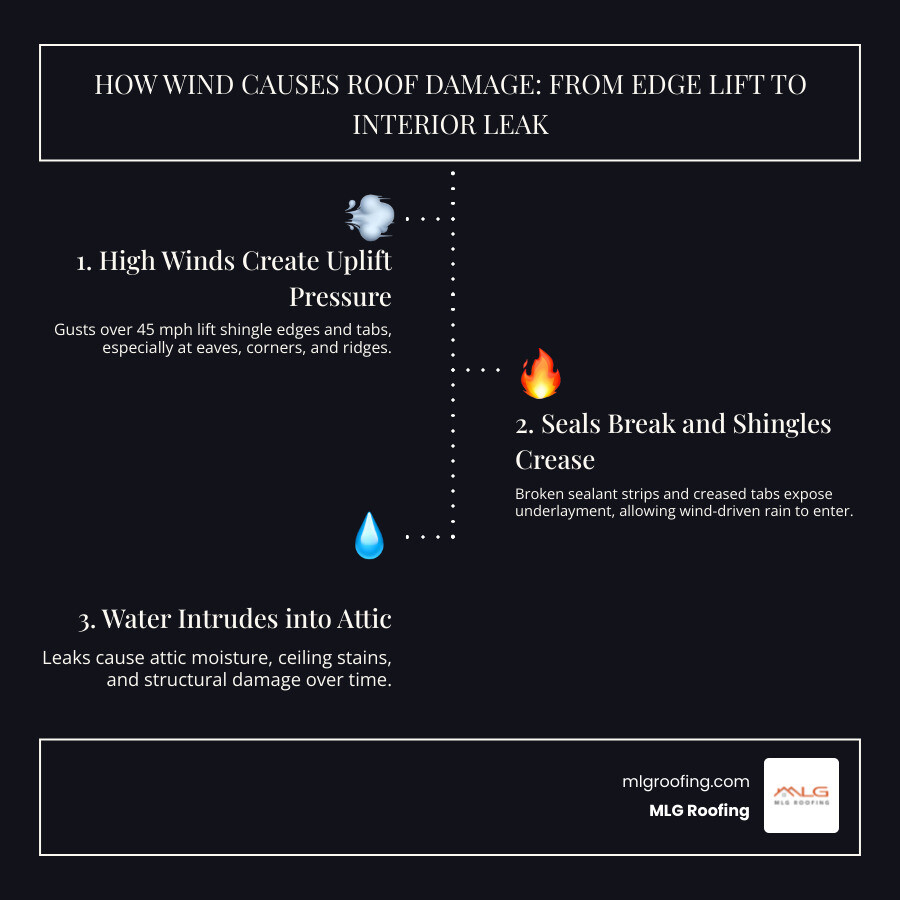
What Wind Damage to Roof Looks Like in Brevard County, FL
In coastal communities like Melbourne, FL and Satellite Beach, FL, wind behaves differently than it does inland. It swirls and creates a vacuum effect known as uplift pressure. This pressure is strongest at the roof edges, ridge caps, and corners. When high winds hit these areas, they don’t just blow across the roof; they create uplift pressure that can pull shingles and roof components away from the decking.

The most common visible signs after a wind event
The most obvious indicator of wind damage to roof systems is missing shingles. You might find them in your yard, in your pool, or hanging from a gutter. However, keep a close eye out for these other visible clues:
- Curled or lifted tabs: Shingles that have been pulled up and didn’t quite settle back down.
- Loose ridge caps: The shingles covering the very peak of your roof are often the first to go.
- Exposed nails: If the shingle above has been torn away, you’ll see the shiny heads of the roofing nails, which are now prime spots for leaks.
- Soffit and fascia damage: High winds can rip the trim right off the eaves, exposing the wooden structure of your attic to the elements.
Hidden wind damage to roof that may not leak right away
The most dangerous type of damage is the kind you can’t see from the driveway. Broken seals occur when the wind lifts a shingle just enough to snap the adhesive strip but doesn’t tear the shingle off. Once that seal is broken, the shingle will flap in the next breeze, eventually creating a “shingle crease”—a horizontal line across the top where the asphalt has cracked.
These compromised shingles may look fine, but they no longer provide a watertight barrier. Over time, wind-driven rain can be forced under these loose flaps, leading to intermittent leaks that only show up during heavy summer squalls in Palm Bay, FL or Rockledge, FL.
Why Florida roofs fail first at edges, corners, and penetrations
Aerodynamics play a huge role in roof failure. As wind hits the vertical wall of a house, it rushes upward and over the eaves. This creates a massive amount of suction at the edges and corners. If the drip edge or the starter shingles aren’t perfectly secured, the wind gets a “fingerhold” and begins the peeling process.
Roof penetrations—like vent boots, chimney flashing, and skylights—are also high-risk zones. The transition between different materials is naturally weaker, and uplift pressure can easily pull metal flashing away from the roof deck, breaking the waterproof seal.
How Much Wind Causes Roof Damage and Which Roofs Are Most at Risk
While most modern roofs are designed to withstand significant force, damage can begin at surprisingly low speeds.
| Wind Speed | Potential Damage Level | Typical Effects |
|---|---|---|
| 45–50 mph | Minor/Threshold | Loose or aged shingles begin to lift; seal failure on brittle roofs. |
| 50–75 mph | Moderate | Shingle sections may tear off; damage to gutters and flashing. |
| 75–95 mph | Severe (Cat 1) | Widespread shingle loss; tree branches puncture roof deck. |
| 110+ mph | Catastrophic | Major structural damage; roof decking may lift. |
Wind speed ranges that commonly damage residential roofs
Most residential roofs in Brevard County, FL are rated for winds up to 90 mph, assuming they were installed perfectly. However, if your roof is more than 10–12 years old, the adhesive strips have likely become brittle. At 45–50 mph—the speed of a standard afternoon thunderstorm in Melbourne, FL—these shingles can start to lift. By the time gusts reach the 58 mph mark (severe thunderstorm threshold), shingle loss becomes much more likely.
Roof conditions that increase wind vulnerability in Brevard County, FL
Several factors can increase a home’s vulnerability to wind damage:
- Roof Age: Older shingles lose their flexibility and their grip.
- Salt Air Exposure: In coastal areas like Merritt Island, FL and Cocoa Beach, FL, salt can accelerate the deterioration of metal fasteners and flashing.
- Gable Roofs: These have two sloped sides and two vertical walls that catch the wind like a sail. Hip roofs (sloped on all four sides) generally perform better in hurricanes.
- Poor Attic Ventilation: If heat and pressure build up in your attic, it can actually contribute to the uplift force pushing your roof shingles from the inside out.
Asphalt shingle vs metal roofing performance in high winds
Architectural shingles are the standard in Brevard County, FL, and when installed with a six-nail pattern, they offer excellent resistance. However, standing seam metal roofing is often considered the “gold standard” for hurricane durability. Because metal panels are interlocked and fastened directly to the deck, they have fewer points where wind can get underneath and start a peel.
How to Inspect for Wind Damage Without Climbing on the Roof
Safety is the priority. You should never climb onto a roof immediately after a storm; shingles may be loose, and the structure could be compromised. You can perform a very effective inspection from the safety of the ground.

Exterior checks from the ground after a storm
Grab a pair of binoculars and walk the entire perimeter of your home. Look at the roof from different angles and distances.
- Check the yard: Look for bits of shingle, grey “sand” (granules), or pieces of metal flashing.
- Inspect the ridgeline: Does the peak of the roof look straight, or are there “crooked” shingles sticking up?
- Look for “shadows”: If a shingle is lifted, it will cast a small shadow underneath it that you can spot with binoculars.
Interior signs that point to roof wind damage
Sometimes the best way to see wind damage to roof areas is from the inside.
- Attic Inspection: Take a flashlight into the attic. Look for wet rafters, damp insulation, or even tiny pinpricks of daylight coming through the roof deck.
- Ceiling Spots: Look for yellow or brown rings on your ceilings, especially near walls or chimneys.
- Musty Odors: If a room suddenly smells like a damp basement after a storm, you likely have water trapped in the walls or attic.
When a professional storm assessment is the safer next step
If you see any of the signs mentioned above, or if your neighbors are all getting their roofs repaired, it is time for a professional assessment. A licensed contractor has the safety equipment to walk the roof and the expertise to find “invisible” seal failures.
For more detailed information on professional evaluations, see our detailed guide to storm damage roof assessment or read our expert tips for identifying roof damage after a storm in Melbourne.
What to Do Immediately After You Find Wind Damage to Roof Areas
Finding a leak or a bare patch on your roof can be stressful, but taking quick, organized steps can save you thousands in secondary water damage.
First steps to limit further water intrusion
- Document Everything: Before you move a single shingle, take photos and videos of the damage from the ground. Include timestamps if possible.
- Contain the Leak: If water is dripping inside, place buckets under the drip. If a ceiling is “bulging” with water, carefully poke a small hole in the center with a screwdriver to drain it into a bucket—this prevents the entire ceiling from collapsing.
- Call for Help: Contact a local roofing contractor for emergency roof repair.
When emergency repair is needed in Melbourne, FL and nearby cities
If you have exposed wooden decking or an active leak, you need emergency roof tarping. In the humid climate of Brevard County, FL, mold can begin to grow within 24 to 48 hours of water intrusion.
Professional tarping involves more than just throwing a blue sheet over the roof; it requires heavy-duty tarps secured with wooden “furring strips” to ensure they don’t blow off in the next gust. We provide 24/7 services for emergency roof repair in Merritt Island, FL and leaking roof emergency repair in Brevard County, FL.
How insurance claims work for wind-related roof damage in Florida
Most Florida homeowners’ policies cover sudden and accidental wind damage. However, the process can be complex.
- Documentation is Key: Your insurance company will want to see that the damage was caused by a specific weather event, not just old age.
- Deductibles: Be aware that many Florida policies have a separate, higher “Hurricane Deductible” (usually 2% to 5% of the home’s value).
- ACV vs RCV: Check if your policy pays “Actual Cash Value” (depreciated) or “Replacement Cost Value.”
A professional roofing contractor can provide a detailed inspection report that helps you navigate this process. For a step-by-step walkthrough, see our guide on navigating insurance claims for roofing damages or check out these Florida roof wind claim documentation tips.
Repair or Replace? Costs, Code, and Long-Term Protection
One of the biggest questions homeowners ask is whether they can simply patch the damage or if they need a total replacement.
When repair makes sense for localized wind damage
If your roof is relatively new (less than 10 years old) and the damage is limited to one small area—perhaps a single branch fell or a few shingles blew off a corner—a repair is often the best route. As long as the surrounding shingles still have a strong adhesive seal and the wooden deck underneath is dry and sturdy, a patch can extend the life of your roof.
When full replacement is the better decision
In Florida, we have the “25% Rule.” Per the Florida Building Code, if more than 25% of a roof section is damaged or needs to be repaired within a 12-month period, the entire roof section must be brought up to current code. Often, this means a full replacement is required.
Additionally, if your shingles are brittle and the “seal strips” are failing across multiple slopes, patching one area won’t stop the next storm from causing more damage. A full replacement ensures you have a secondary water barrier and modern wind-rated fasteners.
Typical wind damage roof costs in Brevard County, FL in 2026
Pricing for roofing services in 2026 depends heavily on the size of your home and the materials chosen.
- Minor Repairs: $500 – $1,500 (fixing a few shingles or flashing).
- Moderate Repairs: $2,000 – $7,000 (replacing a significant section or repairing decking).
- Full Replacement: $12,000 – $30,000+.
These ranges are estimates. Actual costs vary based on roof pitch, accessibility, and whether the underlying plywood (decking) needs to be replaced due to rot. As your local contractor, we handle all the necessary permitting for these projects.
How to reduce future wind damage risk in coastal Central Florida
You can’t stop the wind, but you can make your roof a harder target.
- Six-Nail Pattern: Standard installation often uses four nails; in high-wind zones, we use six.
- Wind-Rated Shingles: Look for shingles rated for 110–130 mph.
- Secondary Water Barrier: This is a peel-and-stick underlayment that stays watertight even if the shingles blow off.
- Regular Inspections: Catching a loose shingle in April is much cheaper than fixing a leak in September.
Learn more about safeguarding your roof against severe Florida weather and preparing your roof for Florida storm season. For a broader look at signs to watch for, see this Florida-focused wind damage overview.
Frequently Asked Questions about Wind Damage to Roof in Brevard County, FL
Can wind damage occur without visible leaks or missing shingles?
Yes. Wind can break the adhesive “seal strip” underneath the shingle. While the shingle stays on the roof, it no longer keeps water out during wind-driven rain. Over time, this leads to hidden rot in the roof deck and mold in the attic.
Does homeowners insurance usually cover wind damage to a roof in Florida?
Generally, yes. Standard policies cover “sudden and accidental” damage from wind and hail. However, they do not cover “wear and tear.” If the insurance adjuster determines the shingles were simply at the end of their lifespan and failed due to old age, the claim may be denied.
How soon should roof repairs be scheduled after a windstorm?
Immediately. Even if you don’t see a leak, a compromised roof is a ticking time bomb. In Melbourne, FL, the next rain is never far away. Prompt action also helps your insurance claim, as it shows you are doing your part to “mitigate” further damage.
Conclusion
Wind damage to roof systems is a reality for every homeowner in Brevard County, FL. Whether you are in Viera, FL or Sebastian, FL, the combination of high winds and salt air puts constant stress on your home’s first line of defense. By knowing the signs—from creased shingles to granule loss—you can act before a small problem becomes a major interior renovation.
MLG Roofing is here to help homeowners across the Space Coast navigate storm recovery. From professional documentation for your insurance company to high-quality roof replacements that meet the latest Florida Building Codes, we focus on durability and peace of mind.
If you suspect your roof has been compromised by recent winds, don’t wait for the next storm to find out for sure. Contact us for an inspection and let’s ensure your home is ready for whatever the Florida sky throws at it next.
For more information on our services, visit our roof repair services page or learn more about hurricane roof repair in Melbourne, FL.