
What to Look for When Hiring for Commercial Roofing in Melbourne, FL
Finding the right contractor for commercial roofing in Melbourne, FL is one of the most practical decisions you’ll make as a business owner or property manager on the Space Coast. You can compare local options among brevard county roofing companies to find a qualified partner, and some properties may qualify for a roof replacement program depending on local initiatives, which can help offset initial capital costs. The roof over your operation is not just a building component — it’s what keeps your tenants comfortable, your inventory dry, and your business running without interruption.
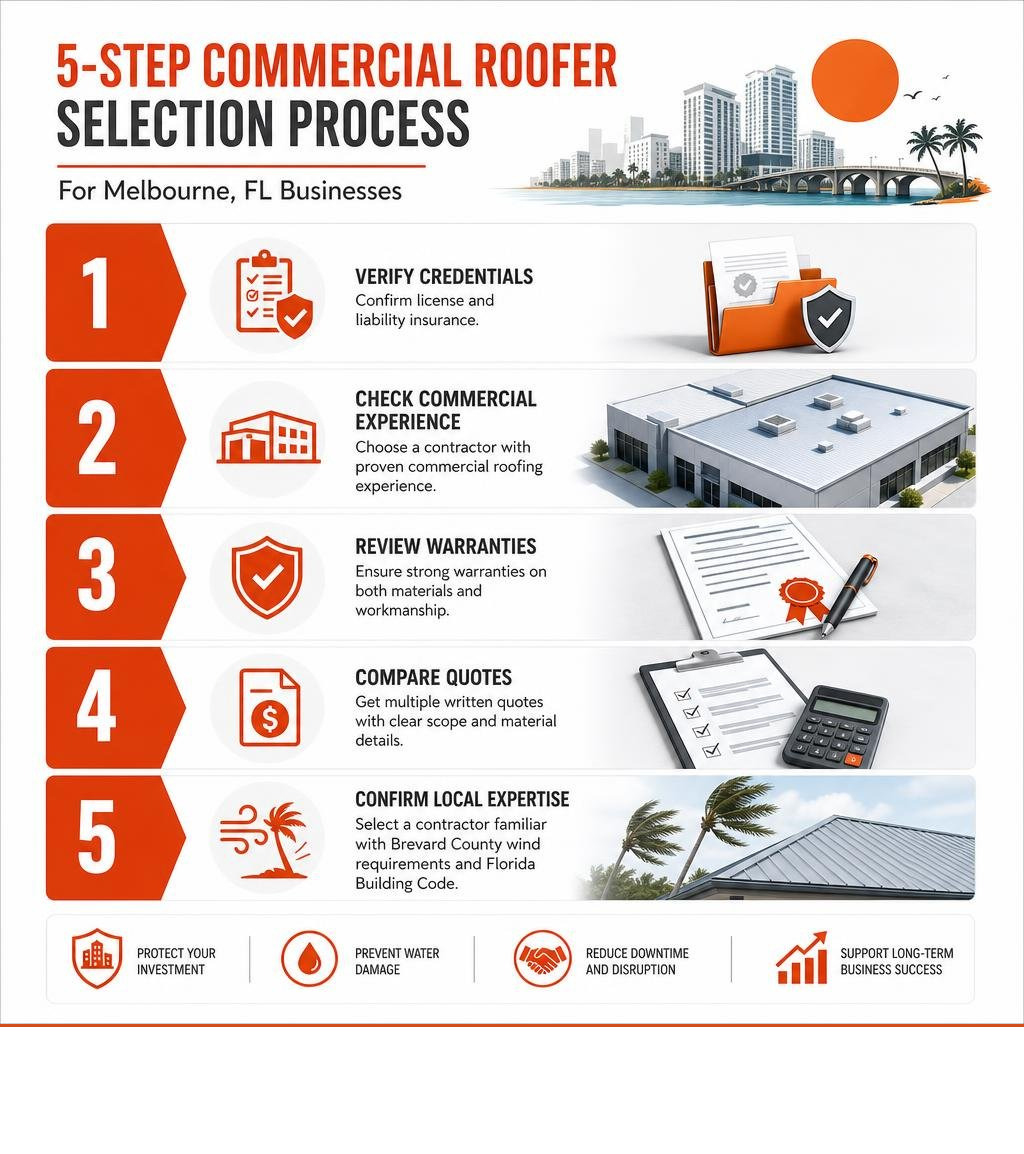
Quick answer: How to choose a commercial roofer in Melbourne, FL
- Verify the contractor holds an active Florida license and carries liability insurance
- Confirm they have experience with commercial roofing systems (not just residential)
- Ask about warranties on both materials and workmanship
- Get multiple written quotes with clear scope and material specifications
- Choose a contractor familiar with Brevard County wind-uplift requirements and Florida Building Code
- Avoid storm chasers or out-of-state contractors with no local track record
Brevard County’s coastal climate — intense UV exposure, high humidity, salt air, and hurricane-season wind events — puts commercial roofs under stress that most other parts of the country simply don’t see. When a roof fails here, the consequences are immediate: water intrusion, mold risk, tenant complaints, damaged inventory, and lost revenue while repairs are arranged.
This guide walks you through what actually matters when evaluating commercial roofing contractors, systems, and quotes — so you can make a clear-headed decision rather than a rushed one.
At MLG Roofing, we work with both residential and select commercial property owners throughout Brevard County. While commercial roofing systems differ significantly from residential roofs, the same principles apply: proper installation, code compliance, preventative maintenance, and choosing the right roofing system for the building’s long-term needs.
Commercial Roofing in Brevard County Is Different
Commercial roofing in Melbourne, FL comes with practical challenges that are different from a typical residential roof replacement. Many commercial buildings use flat or low-slope roof systems, which means drainage, membrane seams, roof penetrations, and rooftop equipment all need to be evaluated carefully before any repair or replacement plan is recommended.
Occupied buildings also require more planning. A roofing project at a retail center, office building, warehouse, medical facility, or restaurant has to account for tenant access, customer parking, noise, debris control, delivery areas, and business hours. A qualified commercial roofing contractor should explain how the work will be staged so daily operations can continue with as little disruption as possible.
Rooftop HVAC units, vents, drains, scuppers, skylights, and parapet walls can all affect how water moves across the roof. Poor drainage is one of the most common causes of premature commercial roof problems, especially during Florida’s heavy summer rain and hurricane season. Before recommending a repair, coating, or replacement, the contractor should inspect these details and identify any areas where standing water, deteriorated flashing, or previous patchwork may create future leaks.
A strong commercial roofing plan should protect more than the building envelope. It should help reduce tenant disruption, support long-term budgeting, improve storm readiness, and keep the property compliant with Florida Building Code requirements for wind resistance and roof performance.
Planning a Commercial Roofing Project Without Disrupting Business
Commercial owners care about operations just as much as the roof itself. Before work begins, your contractor should help you plan how the project will affect tenants, employees, customers, deliveries, parking, and building access.
Tenant and employee notifications should go out before crews arrive so everyone knows the expected timeline, work areas, noise levels, and any temporary access changes. For multi-tenant buildings, this communication is especially important because one tenant’s delivery schedule, customer traffic, or security needs may differ from another’s.
Parking and staging also need to be mapped out early. Roofing crews may need space for dumpsters, material deliveries, lifts, cranes, safety equipment, and temporary storage. A good plan keeps employee parking, customer entrances, loading zones, and emergency access routes as clear as possible while still giving crews enough room to work safely.
Noise and weather delays should also be discussed upfront. Tear-off, fastening, cutting, and equipment movement can disrupt meetings, medical appointments, retail traffic, or restaurant service. In Florida, afternoon storms and high-wind conditions can also affect the daily schedule, so the contractor should explain how open roof areas will be protected if weather interrupts progress.
Security is another practical concern. Commercial roofing projects may involve after-hours staging, roof access points, ladders, equipment, and temporary openings. Property managers should ask how the contractor will secure materials, limit unauthorized roof access, protect tenant spaces, and clean up the site at the end of each workday.
Why Preventative Maintenance Matters for Commercial Roofs
Commercial roofs live and die by maintenance. A roof that looks fine from the parking lot can still have clogged drains, loose flashing, cracked sealants, open seams, punctures near rooftop equipment, or storm debris that creates hidden water problems.
At minimum, commercial roofs should be inspected annually and after major wind or hurricane events. These inspections are especially important on low-slope roofs, where standing water can collect around drains, scuppers, seams, HVAC curbs, skylights, and parapet walls. Catching small problems early can prevent interior leaks, saturated insulation, mold concerns, and expensive emergency repairs.
Drainage should be a top priority during every maintenance visit. Leaves, branches, roofing debris, and wind-blown material can block drains or scuppers, causing water to pond on the roof after heavy rain. Over time, ponding water can accelerate membrane deterioration and place unnecessary stress on the roof system.
Rooftop equipment also deserves close attention. HVAC units, service walkways, vent pipes, and mechanical penetrations are common leak points because technicians may walk across the roof or move panels and tools during routine service. Flashing, sealants, pitch pans, and curbs should be checked regularly to make sure they remain watertight.
A preventative maintenance plan gives commercial property owners better control over budgeting and risk. Instead of waiting for leaks to interrupt tenants or damage inventory, scheduled inspections help extend roof life, document roof condition, and prepare the building before the next severe weather season.
Key Factors When Hiring for Commercial Roofing Melbourne Projects

Selecting a commercial roofing contractor requires a business-focused approach. Unlike residential roofing, which often deals with standard steep-slope shingle applications, commercial roofing involves complex low-slope or flat surfaces, heavy-duty drainage systems, rooftop HVAC equipment, and strict operational safety standards.
When evaluating potential partners, look for established local specialists rather than national storm-chasing companies. National companies often sweep through Brevard County following a major hurricane, offering quick fixes before moving on to the next storm zone. A local contractor who has spent decades serving the Space Coast is invested in the community, understands the microclimate of areas like Cocoa Beach and Merritt Island, and will be available to honor workmanship warranties years down the road.
Before signing any agreement, verify that the contractor has a dedicated commercial division. Commercial projects require specialized safety protocols, such as appropriate fall protection systems, and heavy machinery, including cranes and material hoists. Business owners should also review the contractor’s past project experience to ensure they have successfully completed projects of similar scale, whether it is a retail center in Viera, a warehouse near the Melbourne Orlando International Airport, or a medical office in West Melbourne. Ask whether the contractor has experience coordinating with facility managers, tenants, property management companies, or HOA commercial boards, since these relationships can affect communication, scheduling, access, and disruption control throughout the project. For a closer look at professional roofing options, business owners can learn more about commercial roofing services online.
Evaluating Commercial Roofing Melbourne Quotes
When reviewing quotes for your commercial property, the lowest bid is rarely the best choice. An unusually low estimate often indicates that a contractor is cutting corners, using sub-standard materials, or failing to include essential project components like permit fees, safety equipment, or code-mandated insulation upgrades.
A professional commercial roofing proposal should be highly detailed and transparent. It must outline the exact scope of work, including the removal of old materials, inspection of the underlying structural deck, and replacement of any damaged wood or metal. The quote should specify the exact brand, thickness, and attachment method of the insulation and membrane systems. Additionally, ensure the proposal includes a realistic project timeline, clear payment milestones, and a plan for managing debris, such as on-site dumpster placement and daily cleanup.
Warranties and Guarantees for Commercial Roofing Melbourne Systems
A commercial roof is a major capital investment, and protecting that asset requires robust warranty coverage. Reputable contractors typically offer two distinct types of warranties: manufacturer warranties and contractor workmanship guarantees.
Manufacturer warranties cover defects in the roofing materials themselves and, in many cases, can range from 10 to 30 years depending on the system type and thickness. For low-slope membrane systems like TPO or PVC, business owners should look for a No Dollar Limit (NDL) warranty. An NDL warranty means that if a material failure occurs, the manufacturer will cover the full cost of repairs or replacement without a financial cap.
Workmanship guarantees, on the other hand, are provided directly by the roofing contractor and cover installation errors. Some manufacturers also offer single-source warranties, which bundle both material performance and installation quality under a single policy backed by the manufacturer. This provides the highest level of long-term protection for your business.
Common Commercial Roofing Services: Repairs vs. Replacement
Managing a commercial facility means balancing maintenance budgets with structural needs. Roofs on the Space Coast face continuous wear and tear, making regular professional inspections essential. Identifying issues early through advanced leak detection and routine maintenance can prevent minor issues from escalating into major structural failures.
When leaks occur, professional roofers use specialized diagnostics to locate water intrusion pathways behind walls or under membranes. If the structural integrity of the roof deck is sound and the insulation is dry, targeted repairs or a liquid-applied roof coating may be sufficient to extend the roof’s lifespan. However, if water has saturated the insulation layers across a wide area, or if the roof has reached the end of its functional life, a full replacement is required. For local property owners, understanding the value of proactive care is covered in detail in our guide on regular roof maintenance, which outlines key inspection intervals.
Selecting the Right Commercial Roof System for the Space Coast Climate
Choosing the right material for your commercial property depends on your building’s structure, slope, and specific operational needs. The table below compares the three most common commercial roofing systems installed across Brevard County.
| Roofing System | Hurricane Resistance | UV & Heat Resistance | Salt-Air Suitability | Key Business Benefit |
|---|---|---|---|---|
| TPO (Thermoplastic Polyolefin) | Excellent (when heat-welded) | Outstanding (highly reflective white surface) | High | Lowers cooling costs and offers cost-effective flat roof protection |
| PVC (Polyvinyl Chloride) | Superior (highly durable seams) | High (resists chemical and grease exposure) | Outstanding | Best for restaurants, food processing, and coastal chemical exposure |
| Metal Roofing (Standing Seam) | Maximum (highest wind-rating) | High (absorbs and radiates heat; solar-ready) | High (requires marine-grade coatings near salt water) | Longest lifespan and exceptional architectural appeal |
Each of these systems offers unique advantages for Space Coast businesses:
- TPO Systems: TPO is one of the most popular choices for flat and low-slope commercial buildings in Florida. Its naturally reflective white surface bounces sunlight away from the building, significantly reducing heat absorption. This lowers the load on rooftop HVAC units and helps business owners manage their monthly utility bills.
- PVC Systems: PVC membranes share many of the energy-efficient qualities of TPO but offer enhanced resistance to chemicals, grease, and animal fats. This makes PVC the industry standard for restaurants, manufacturing facilities, and properties located directly along the salt-heavy coastal winds of Satellite Beach or Indian Harbour Beach.
- Metal Roofing: Standing-seam metal roofs offer unmatched longevity and wind resistance. Because the fasteners are concealed, there are fewer penetrations where water can enter. Metal roofs are highly durable, easily shedding heavy tropical rains and resisting wind damage during major storm events.
Investing in a highly reflective, energy-efficient roofing system is a smart way for commercial property owners to improve their bottom line. To learn more about how cool roofing technologies can lower operational costs, read about energy efficient roofing to see how these systems perform over time.
Frequently Asked Questions About Space Coast Commercial Roofing
Managing a commercial roofing project requires careful coordination to minimize business disruption and protect your daily operations. Property owners must plan for temporary changes in parking, material storage, and potential noise during installation.
If your business experiences storm damage, documenting the impact immediately is critical. Take clear photographs of any interior water damage, roof-level debris, or compromised flashing. A reputable local contractor will provide detailed damage assessments, photographic reports, and written estimates formatted to assist your team when coordinating with insurance adjusters and preparing documentation. For more advice on protecting your property, refer to our resource on preventing common roofing problems to understand potential vulnerabilities.
How much does a commercial roof replacement cost in Melbourne, FL?
Commercial roofing costs are highly variable and cannot be accurately determined without an in-person professional evaluation. Every commercial building has unique structural demands that influence the overall investment.
Key factors that affect the cost of a commercial roof replacement include:
| Factor | Effect |
|---|---|
| Roof size | Higher material cost |
| Roof type | TPO vs. PVC vs. metal pricing differences |
| Occupancy | Phased installation may be needed |
| Tear-off | More labor and disposal requirements |
| Insulation | Code upgrades or wet insulation replacement may be required |
| Rooftop equipment | More flashing work around HVAC units, vents, and penetrations |
- Roof Size and Slope: Larger surface areas require more materials and labor, while complex slopes may require specialized safety equipment.
- System Type: The choice of material (such as TPO, PVC, or metal) plays a significant role in the initial cost and long-term value.
- Accessibility: Multi-story buildings or properties with limited ground space for staging materials and cranes require more complex logistics.
- Insulation Condition: If moisture has penetrated the existing roof layers and saturated the insulation, the damaged insulation must be removed and replaced to meet Florida Building Code standards.
- Building Occupancy: Facilities that require continuous, uninterrupted operations (such as medical centers or retail spaces) may require staged installations or after-hours work, which can affect labor costs.
How long does a commercial roof replacement typically take?
The duration of a commercial roofing project depends on the size of the building, the complexity of the roof system, and local weather conditions. Many standard commercial replacements can take anywhere from several days to a few weeks, depending on weather and complexity.
A professional contractor will work closely with your facility manager to establish a clear timeline and minimize tenant complaints. To prevent operational disruption, staging areas for materials are carefully planned, and high-noise activities are often scheduled during off-peak hours. While afternoon rain showers are common during Florida summers, experienced crews monitor local weather closely and secure the roof in sections to ensure the building interior remains dry throughout the process.
Can my business stay open during a commercial roof replacement?
Usually, yes. Many commercial roofing projects can be completed while the business remains open, especially when the contractor plans the work in phases and coordinates closely with the property owner, facility manager, tenants, or on-site staff.
The key is staging. Materials, dumpsters, lifts, and safety equipment should be placed where they do not block customer entrances, employee parking, delivery zones, or emergency access routes. For larger buildings or multi-tenant properties, the work may be divided into sections so only one part of the roof or property is affected at a time.
Noise is another important concern. Tear-off, fastening, cutting, and equipment movement can be disruptive, so a good contractor should discuss high-noise activities in advance and, when possible, schedule them around peak business hours, appointments, deliveries, or customer traffic.
Safety planning also matters. Crews should control debris, mark work zones, secure roof access points, protect walkways, and communicate any temporary access changes before work begins. With clear scheduling, daily cleanup, and proactive communication, many Melbourne businesses can continue operating while their commercial roof is repaired or replaced.
Can a commercial roof be repaired instead of fully replaced?
In many cases, a commercial roof can be successfully repaired or restored rather than completely replaced. If the underlying roof deck is structurally sound, the insulation is dry, and the membrane is generally in good condition, targeted repairs are a highly cost-effective way to extend the roof’s operational life.
However, the decision depends heavily on the extent of the damage and local building code requirements. Under the Florida Building Code, if a roof has sustained extensive damage or has multiple layers of old roofing materials, a complete reroof may be required. A professional physical inspection and moisture evaluation are necessary to determine the safest and most compliant path forward for your property.
Conclusion

Choosing the right partner for your commercial roofing project is a critical decision that affects your business’s bottom line and long-term security. By focusing on licensed local specialists who understand the unique wind, heat, and moisture challenges of the Space Coast, you can ensure your commercial property remains protected for decades to come.
At MLG Roofing, we bring local expertise, high-quality materials, and a commitment to clear communication to every commercial and residential project we undertake across Brevard County. Whether your property needs a minor repair, a preventative maintenance inspection, or a complete system upgrade, our team is ready to deliver dependable, code-compliant solutions tailored to your business. Contact us today to schedule a commercial roof replacement evaluation and take the first step toward securing your commercial investment.