
Can Concrete Roof Tiles Withstand Hail in Brevard County, FL?
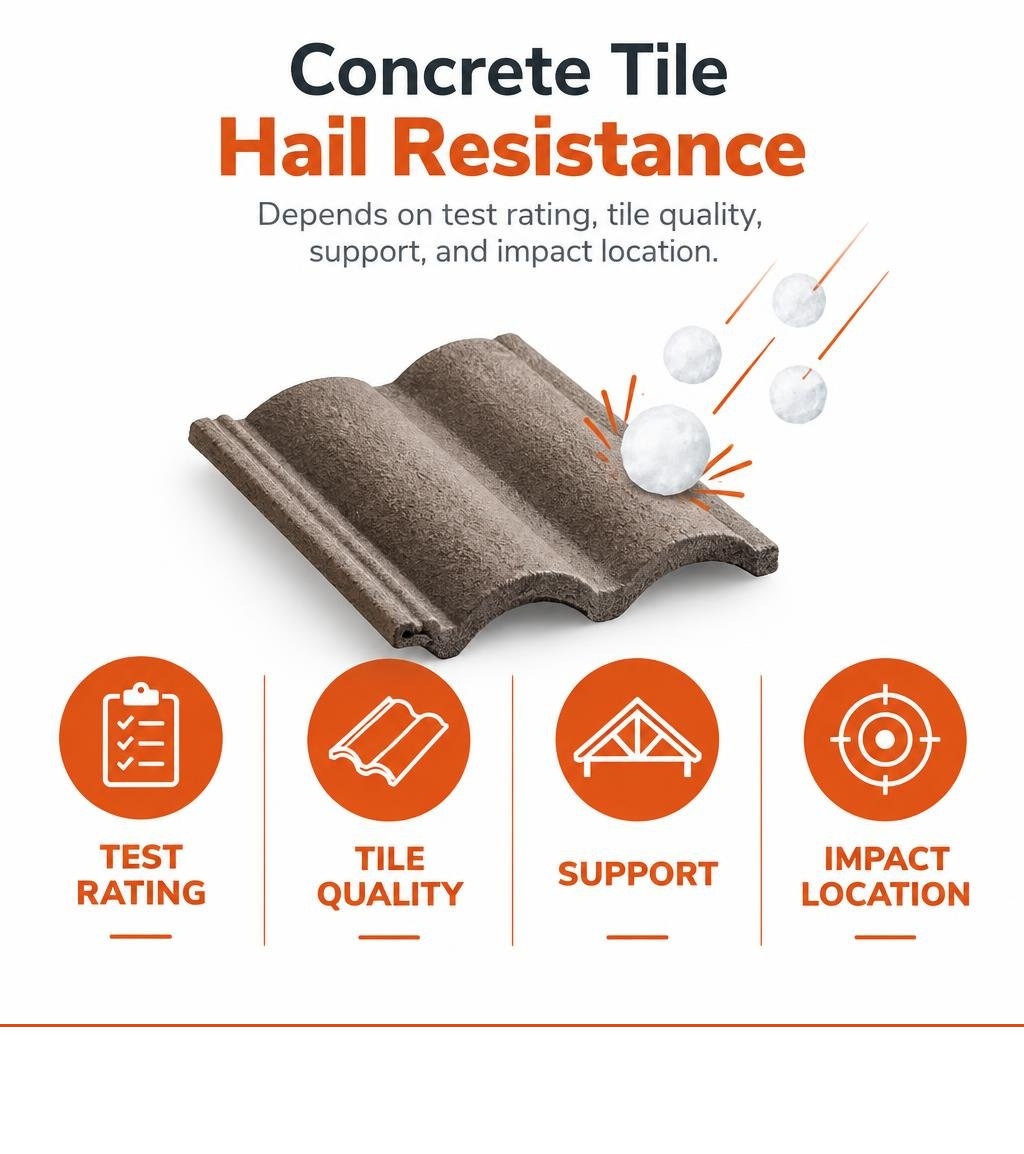
Concrete tile impact strength varies by tile and installation. Some concrete roof tiles pass Class 4 ice-ball tests without visible cracks, but that does not mean every tile can survive unusually large hail or wind-blown debris. Tile thickness, manufacturing quality, support, and where the hail strikes all affect the result.
For a Space Coast home, looking at impact test results for specific profiles such as architectural roof tiles helps determine expected storm performance. If your roof has been hit by hail, a comprehensive inspection can find cracked or loosened tiles that are hard to spot from the ground.
Engineering Standards and Testing for Concrete Tile Impact Strength
Evaluating the impact performance of rigid roofing materials requires standardized laboratory testing to simulate extreme weather phenomena. In coastal Central Florida, roofing systems face severe thunderstorms, convective hail events, and hurricane-force wind debris. Independent engineering laboratories utilize established standardized test protocols to evaluate tile performance under high-velocity mechanical stresses.
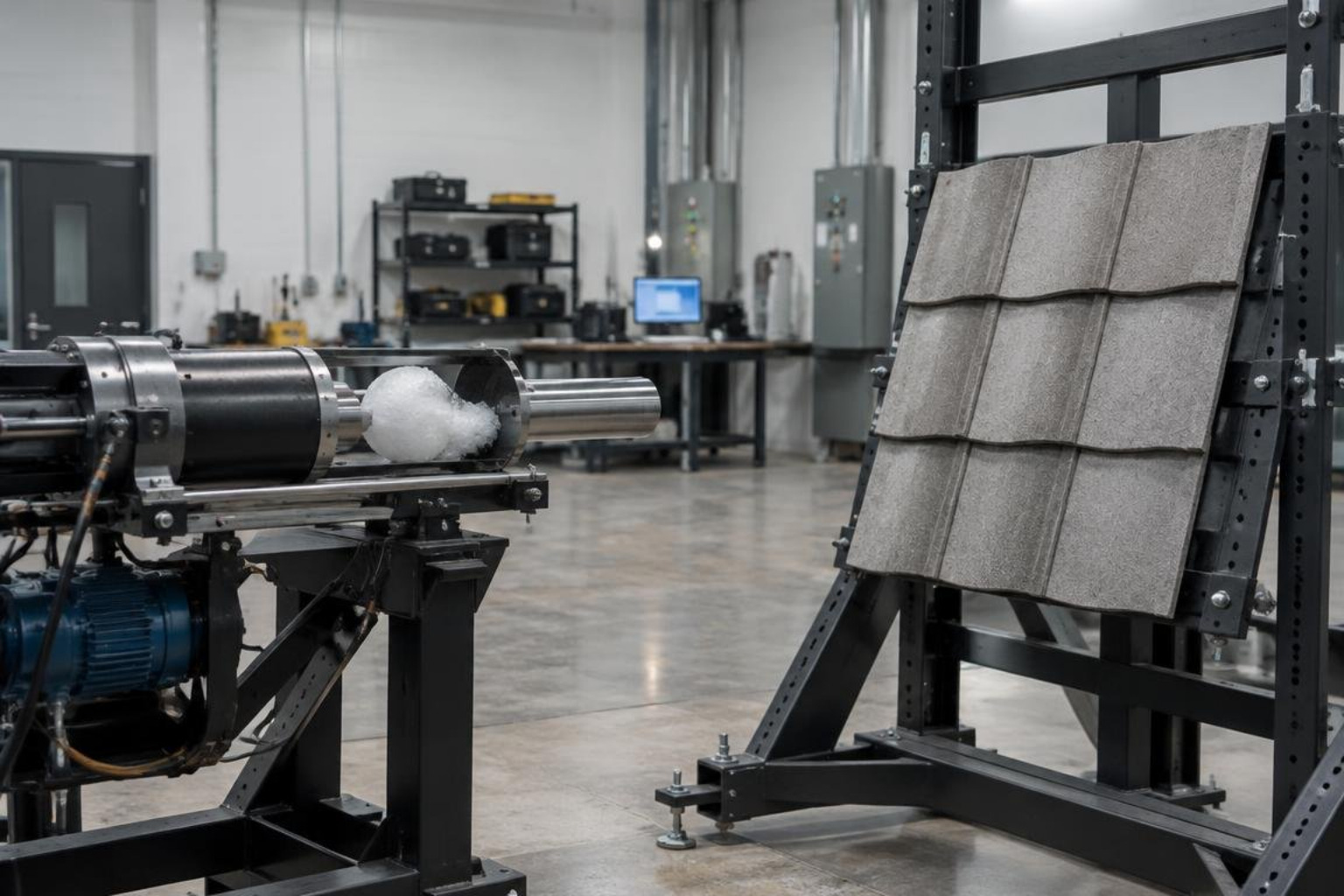
The most rigorous standard for rigid roofing materials is ANSI/FM 4473. Unlike tests that use rigid metal spheres, ANSI/FM 4473 utilizes propelled freezer-formed ice balls to accurately replicate the density, temperature, and projectile dynamics of natural hailstones. A Class 4 rating represents the highest level of performance under this standard. According to formal laboratory test criteria, Class 4 compliance requires tiles to withstand direct impacts from 2.0-inch diameter ice balls propelled at 105 feet per second (approximately 71.6 mph), generating roughly 23.75 ft·lbf of kinetic energy without exhibiting through-cracking, edge chipping, or catastrophic structural failure.
A complementary standard, UL 2218, drops solid steel spheres from varying heights onto roofing materials to assess crack resistance and mechanical resilience. While UL 2218 is common across steep-slope shingle systems, the rigid mass of concrete tiles makes the ANSI/FM 4473 ice ball standard a more representative benchmark for hail performance. For lower-energy factory quality control, ISO 10545-5 provides a non-destructive method measuring restitution at low energies (0.27 J), though it does not evaluate projectile destruction thresholds.
| Standard | Projectile Type | Speed / Drop Height | Kinetic Energy | Failure Criteria |
|---|---|---|---|---|
| ANSI/FM 4473 (Class 4) | 2.0-inch Ice Ball | 105 ft/s (71.6 mph) | ~23.75 ft·lbf (32.2 J) | Visible cracking, splitting, or breakage |
| UL 2218 (Class 4) | 2.0-inch Steel Ball | 20-foot drop | ~23.7 ft·lbf (32.1 J) | Cracking through the underside layer |
| ISO 10545-5 | 19 mm Steel Ball | Low-height drop | ~0.20 ft·lbf (0.27 J) | Rebound coefficient reduction (<0.50) |
Coefficient of Restitution and Impact Damage Mechanics
The coefficient of restitution ($e$) defines the ratio of rebound velocity to impact velocity, serving as a non-destructive measure of how much kinetic energy a tile absorbs versus reflects:
$$e = sqrt{frac{h_{text{rebound}}}{h_{text{drop}}}}$$
When an object strikes a rigid surface, an ideal elastic response yields an $e$-value closer to 1.0, meaning energy is reflected back into the projectile. In heavy-duty floor classifications, materials must demonstrate an $e$-value $ge 0.85$ to withstand heavy mechanical drops without structural deterioration. Normal-duty ratings fall around 0.70, while light-duty materials hover at 0.50.
When impact energy exceeds the material’s elastic limit, permanent microstructural damage occurs. Research on brittle ceramic and mineral matrix substrates in the Resistance to impact of porcelain stoneware tiles study outlines a seven-stage damage progression:
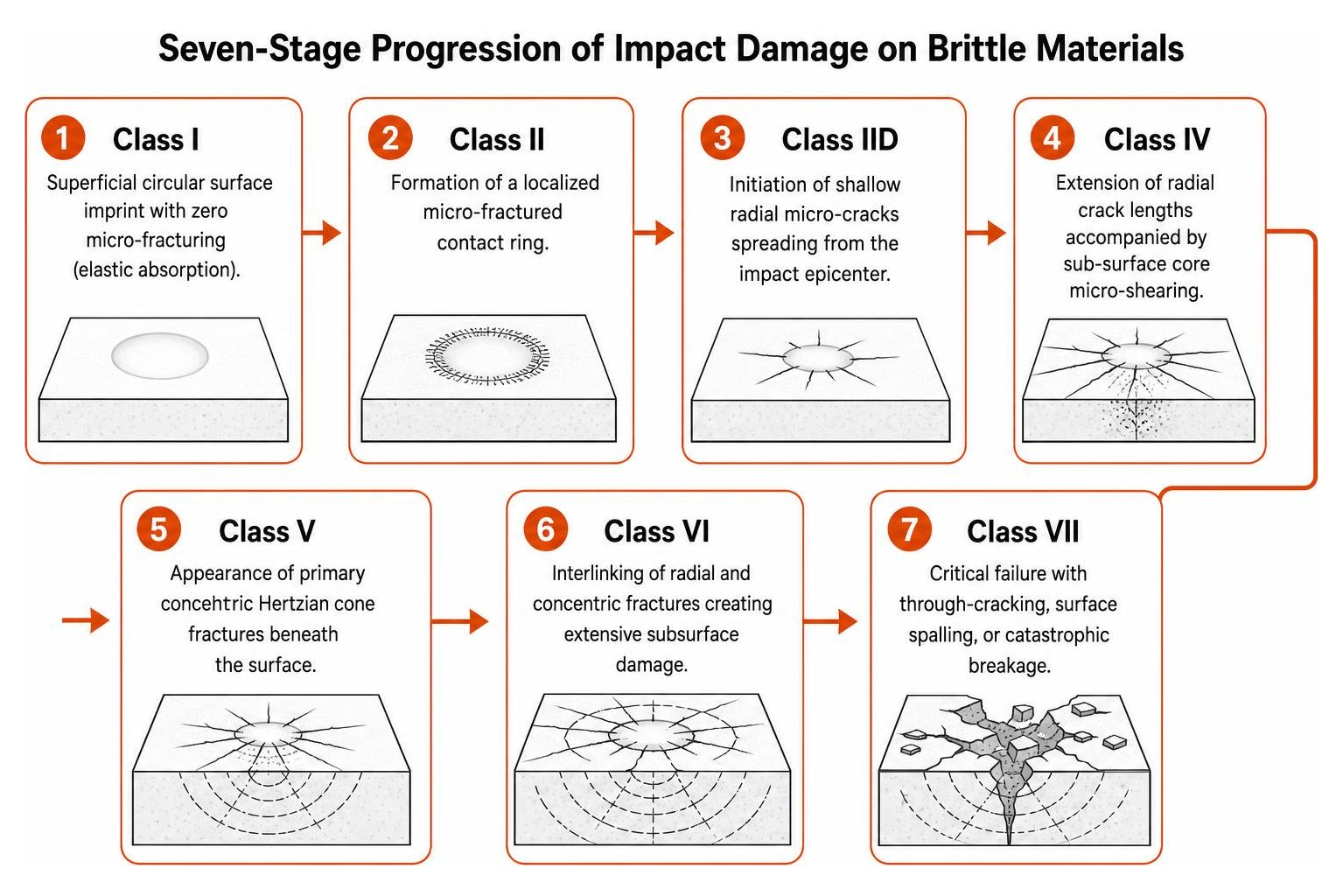
- Class I: Superficial circular surface imprint with zero micro-fracturing (elastic absorption).
- Class II: Formation of a localized micro-fractured contact ring.
- Class IID: Initiation of shallow radial micro-cracks spreading from the impact epicenter.
- Class IV: Extension of radial crack lengths accompanied by sub-surface core micro-shearing.
- Class V: Appearance of primary concentric Hertzian cone fractures beneath the surface.
- Class VI: Multiple nested Hertzian cone cracks forming fully developed fracture paths.
- Class VII: Complete through-body fragmentation and mechanical collapse.
High-density concrete tiles are engineered to absorb localized kinetic shock, delaying the transition from Class II contact rings to destructive Class V Hertzian cone fractures.
How Tile Thickness and Density Govern Concrete Tile Impact Strength
Tile profile thickness, cured compressive strength, and aggregate density directly dictate mechanical strength. Thicker cross-sections distribute impact loads over a larger surface area, mitigating peak localized stress.
Data demonstrates that increasing cross-sectional thickness substantially increases impact resistance. In vitrified and dense mineral matrices, increasing thickness from 7 mm to 10 mm elevates the coefficient of restitution from 0.73 to 0.79, while expanding thickness from 8 mm to 16.5 mm elevates restitution values from 0.76 to 0.88. For concrete roofing tiles, manufacturing profiles with dense aggregate matrix designs reduces porosity, increasing fracture toughness and flexural strength.
Material Comparison: Concrete Tile vs. Asphalt Shingles and Metal Roofing
Understanding how concrete tiles compare to alternative roofing systems requires analyzing structural behavior under point impacts, wind uplift, and coastal weathering.

When evaluating how to choose the best roof material for Florida weather, homeowners must weigh the rigid mass of concrete against flexible asphalt shingles and malleable metal panels.
| Roof Material | Impact Damage Mode | Typical Wind Resistance | Expected Lifespan | Coastal Salt / UV Resistance |
|---|---|---|---|---|
| Concrete Tile | Localized cracking or chipping | 125+ mph | 40–50+ Years | Exceptional; inert to UV and salt spray |
| Architectural Shingles | Granule loss, fiberglass mat rupture | 110–130 mph | 15–25 Years | Moderate; susceptible to granule erosion and UV |
| Standing Seam Metal | Cosmetic denting, scratch to coating | 140+ mph | 40–70 Years | High (with marine-grade aluminum / finishes) |
Attachment Methods and Wind-Uplift Performance
Concrete tiles rely on secure attachment systems to resist wind uplift and projectile impacts. Academic findings published in the ASCE journal regarding Uplift Capacity and Impact Resistance of Roof Tiles indicate that mortar-set and mechanical foam adhesive attachments exhibit differing mechanical behaviors under storm loads.
While foam adhesives bond well to non-porous surfaces, mortar-set concrete tile assemblies provide high uplift resistance and structural rigidity against cyclic winds. Concrete tiles can sustain sustained winds exceeding 125 mph when installed using approved fastening schedules and storm clips. Tile profile designs, such as double Roman roof tiles, feature contoured water channels and interlocking laps that channel water away while locking contiguous rows together to resist wind-driven debris.
Real-World Durability and Structural Support Requirements
Concrete roof tiles are heavy roofing materials. A standard single tile can weigh around 14.7 lbs, resulting in an installed dry dead load of 900 to 1,200 lbs per roofing square (100 sq ft).
Before installing a concrete tile roof on a home in Melbourne or Palm Bay, structural rafters, trusses, and roof decking must be evaluated by a professional to ensure they can support this dead load alongside variable live loads (such as wind pressures and service technicians).
The heavy mass of a concrete tile roof provides thermal mass and aerodynamic stability during sustained severe weather. Premium tile specifications highlight how interlocking tongue-and-groove joints distribute localized impact loads across multiple adjacent tiles, minimizing localized flexural failure.
Evaluating Concrete Tile Impact Strength Against Severe Hail Storms
During severe convective storms across the Space Coast, hailstones strike at varying trajectories driven by erratic wind gusts. While direct perpendicular strikes deliver maximum kinetic shock to tile centers, oblique strikes concentrate shear forces along overlapping edges and exposed noses.
High-density concrete tiles demonstrate resilience against direct surface impacts. However, unsupported perimeter edges remain vulnerable to chip damage if struck by wind-driven debris. Utilizing factory-applied acrylic sealants helps prevent water penetration into micro-fissures, preserving the core matrix through wet-dry climate cycles.
Maintenance Strategies to Preserve Impact Resistance
While concrete tile roofs can last 40 to 50 years or more, their long-term impact strength depends heavily on proper maintenance and protection from mechanical point loads.
- Eliminate Unnecessary Foot Traffic: Improper foot traffic is a leading cause of cracked tiles. Point loads concentrated on the unsupported center or lower edge of a tile can cause brittle fracture. When roof access is required for trades, walk boards, foam pads, or specific transfer methods across tile laps must be utilized.
- Inspect for Hidden Micro-Cracks: Hairline fractures from falling branches or moderate hail allow moisture to reach the underlayment. Regular professional visual evaluations identify damaged units before water damage develops. Homeowners can review the importance of scheduling tile roof inspections to protect their roof underlayment.
- Clear Organic Growth and Debris: Moss, algae, and accumulated pine needles trap moisture in interlocks, increasing risk of water damming and freeze-thaw surface scaling during cold snaps.
- Maintain Underlayment Redundancy: Even when concrete tiles resist structural impact, the secondary underlayment serves as the final waterproofing barrier. If cracked tiles are found, prompt replacement prevents UV degradation of the underlayment.
When evaluating repair versus full replacement following severe weather in communities like Rockledge, Viera, or Cocoa Beach, decisions depend on factors such as overall damage extent, permitting history, current Florida Building Code requirements, local building department guidance, and an in-person professional evaluation. Roofing costs in Florida are highly variable based on roof pitch, tile profile availability, decking condition, and accessibility.
Frequently Asked Questions About Concrete Tile Durability
Can concrete roof tiles withstand Class 4 hail without cracking?
Concrete tiles tested and certified under ANSI/FM 4473 Class 4 are designed to withstand 2.0-inch propelled ice balls travelling at 105 ft/s without showing through-body cracks or shattering. However, uncertified or thinner profiles may suffer edge chipping or micro-fracturing under equivalent real-world storm conditions.
How does foot traffic affect the impact strength of concrete tiles?
Foot traffic creates point loads that can exceed the flexural bending capacity of unsupported tile sections. Stepping on the center or unsupported edges can induce hairline cracks (Class II/III micro-fissuring). These cracks reduce the tile’s structural integrity, making it far more likely to fracture during subsequent hail or storm debris impacts.
Do concrete tiles lose their impact resistance as they age?
High-quality concrete continues to hydrate and maintain compressive strength over time. However, decades of surface weathering, loss of protective slurry coats, and organic growth can increase surface porosity. While the concrete core remains structurally strong, unmaintained tiles with weathered surfaces may exhibit minor surface spalling when struck by hail.
Conclusion
Ensuring long-term storm resilience against hail and wind-driven debris requires durable materials and proper roof design. Concrete tile impact strength offers strong defense against severe weather across Brevard County, FL, including communities like Melbourne, Palm Bay, Merritt Island, and Sebastian. When manufactured to strict Class 4 standards and supported by engineered roof framing, concrete tiles provide decades of structural protection.
For Space Coast homeowners assessing storm impact damage or evaluating roof replacement options, MLG Roofing provides comprehensive residential roofing services, detailed storm damage assessments, and leak evaluations tailored to coastal Florida environments.