Why Florida Roof Inspections Matter in Brevard County, FL
Florida roof inspections check a roof’s condition, age, and signs of damage. In Brevard County, FL, a homeowner may need one when an insurer requests a roof condition report, when buying coverage for an older home, or after a storm. A permitted roof replacement also requires building inspections, which differ from reports requested by an insurance company.
The right inspection depends on the question you need answered. A roof condition report helps an insurer assess remaining useful life, while reviewing annual roof inspection advantages helps homeowners stay ahead of renewal deadlines. A wind mitigation report documents features that may qualify for insurance discounts. A 4-point inspection reviews the roof along with electrical, plumbing, and heating and cooling systems.
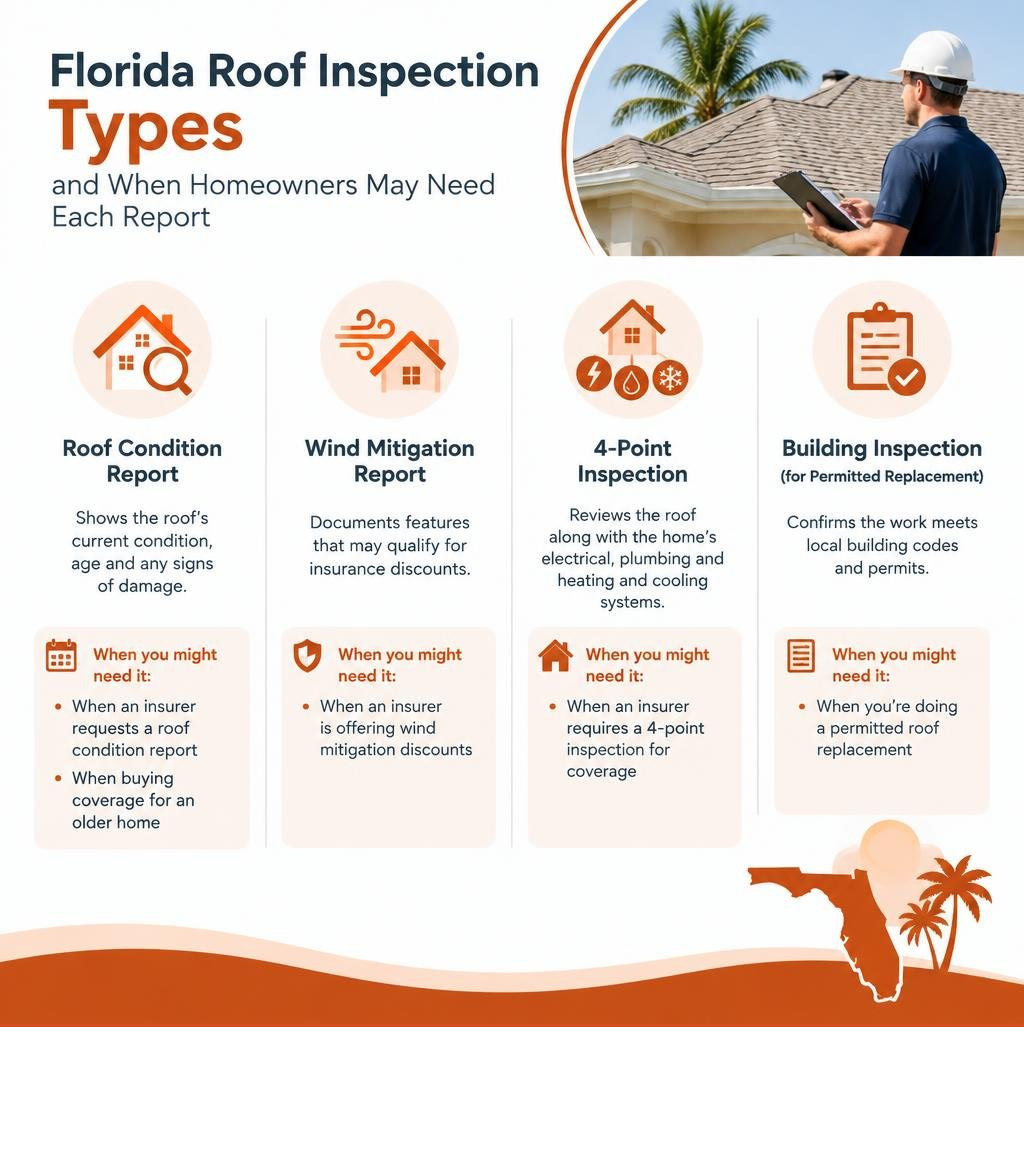
Understanding insurance roof inspections clarifies which form a carrier requests, while evaluating roof inspection costs makes it easier to plan for necessary evaluations.
Navigating Florida Roof Inspections: RCF, Wind Mitigation, and 4-Point Reports
Along the Space Coast, insurance underwriters evaluate roof risk closely. Tropical storm activity, intense sunlight, and salt air accelerate normal wear, prompting carriers to request structured paperwork before issuing or renewing policies. Understanding insurance roof inspections helps homeowners request the exact report their carrier requires.
| Inspection Type | Primary Purpose | Key Features Evaluated | Typical Scope |
|---|---|---|---|
| Roof Condition Form (RCF) | Verify age and remaining useful life for carrier underwriting | Shingle/tile condition, deck integrity, active leaks, age | Roof covering and attic space |
| Wind Mitigation | Identify wind-resistive construction for premium credits | Roof geometry, deck nailing, clips/straps, underlayment | Roof structure, fasteners, openings |
| 4-Point Inspection | Evaluate major systems on aging properties | Roof covering, electrical panels, plumbing lines, HVAC | Four major home systems |
Roof Condition Form (RCF) and Useful Life Certifications
An insurer uses a Roof Condition Form (RCF) or Roof Inspection Form to confirm that an existing roof covering remains watertight and structurally sound. During this visual assessment, the evaluator inspects the outer covering from the ground, ladder, or roof surface, checking for missing shingles, cracked tiles, rusted metal panels, and deck deflection.
The inspector estimates the remaining useful life of the system. While evaluating what a roof inspection really costs, homeowners often find that scheduling an RCF inspection early provides the documentation needed to prevent sudden policy disruptions.
Wind Mitigation Inspections and Form OIR-B1-1802
A wind mitigation assessment documents structural construction details that reduce wind damage during severe storms. The findings are submitted on the standardized Florida Office of Insurance Regulation Form OIR-B1-1802.
Under Florida law, insurance carriers must provide actuarially reasonable premium discounts for verified wind-resistive features. Key items evaluated on Form OIR-B1-1802 include:
- Roof Geometry: Hip roof designs typically earn higher discounts than gable profiles because they deflect wind more efficiently from all sides.
- Roof-to-Wall Attachments: Evaluators look inside the attic to determine whether trusses connect to wall plates with toe-nails, single clips, or double hurricane wraps.
- Roof Deck Attachment: The size and spacing of fasteners (such as 8d ring-shank nails driven at 6-inch intervals) determine resistance to uplift pressure.
- Secondary Water Resistance (SWR): Self-adhering polymer-modified bitumen tape or direct-to-deck underlayment protects sheathing seams if primary shingles tear away.
4-Point Inspections for Older Residential Properties
When a single-family home reaches a certain age threshold—often 15 to 20 years, depending on carrier underwriting rules—insurers generally require a 4-point inspection before writing a policy. This report reviews:
- Roofing System: Age, material, visible damage, and estimated remaining life.
- Electrical System: Panel types, wiring methods, and service capacity.
- Plumbing System: Supply line materials, water heater condition, and active leaks.
- HVAC System: Heating and cooling equipment age, operational status, and maintenance.
Florida’s 15-Year Roof Rule and Insurance Mandates
Navigating insurance rules in Florida requires familiarity with state legislation designed to balance policyholder security with insurance market stability. Reviewing Florida Statute 627.7011 guidelines helps property owners understand how age thresholds affect policy renewals.
Why Florida Roof Inspections Are Essential Under the 15-Year Rule
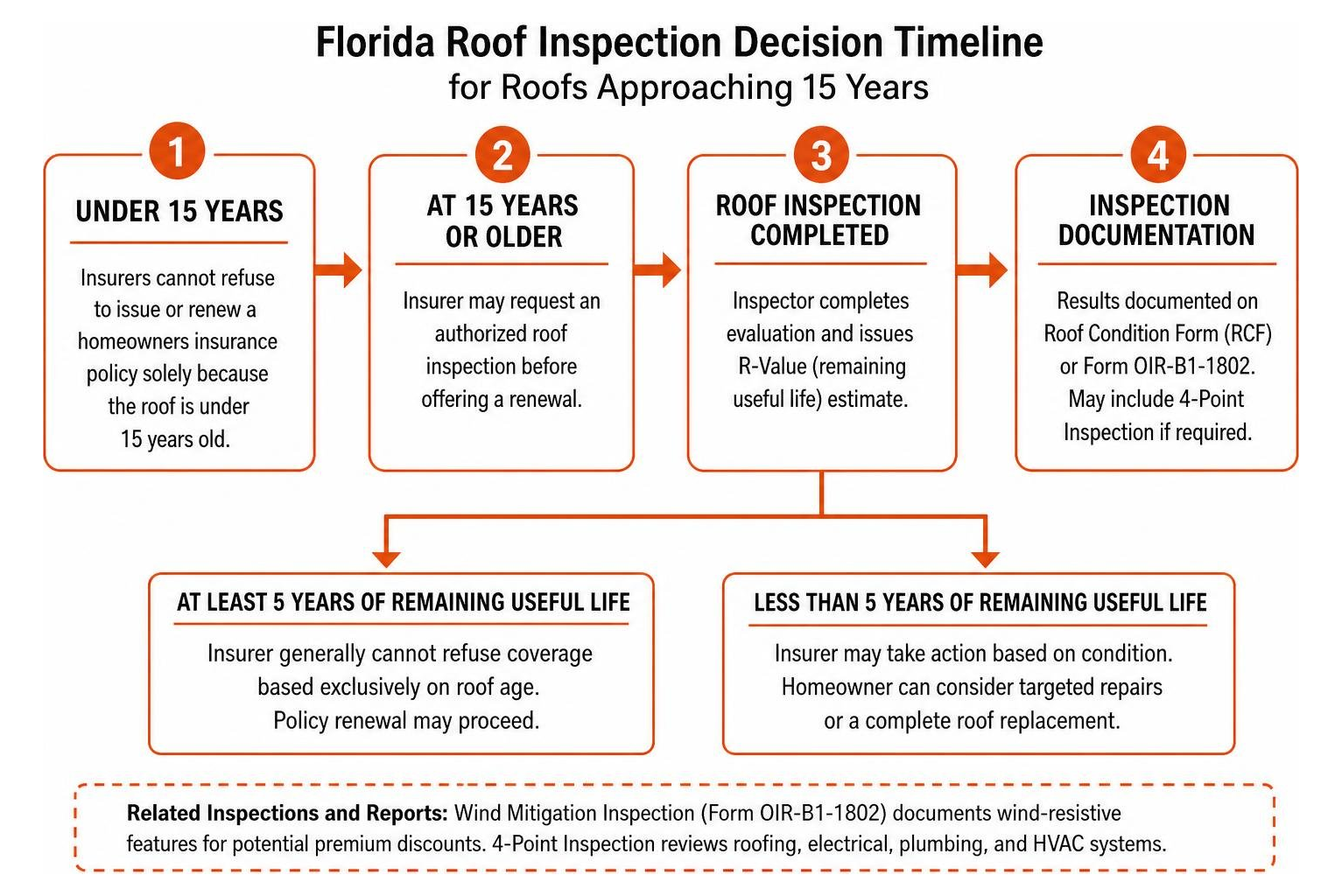
Under Florida Statute 627.7011, authorized insurers cannot refuse to issue or renew a homeowners insurance policy solely because an asphalt shingle roof is under 15 years old.
Once a roof reaches or exceeds the 15-year mark, an insurer may request an authorized inspection before offering a renewal. If the inspection confirms that the roof system has at least 5 years of remaining useful life, the insurer generally cannot refuse coverage based exclusively on roof age. If an inspection reveals widespread deterioration, property owners can evaluate whether targeted repairs or a complete roof replacement offers the most reliable long-term protection.
Insurance coverage decisions remain documentation- and policy-specific. Coverage may depend on the policy language, exclusions, deductibles, roof-age provisions, and the carrier’s review of the inspection report. If included in a policy, Ordinance or Law coverage may help with certain code-required upgrade costs after a covered loss; homeowners can review their policy documents or speak with their insurer or licensed insurance professional for details.
Legislative Updates and Senate Bill 808
Recent legislative updates, including measures addressed in Senate Bill 808, refine how roof conditions are verified across residential policies. These updates broaden the categories of licensed professionals authorized to issue roof certifications and address low-slope roof coverings where protective coatings may add certified useful life. Policyholders must verify that their inspector holds current state credentials so documentation meets carrier guidelines.
Preparing for Florida Roof Inspections Ahead of Hurricane Season
Planning an evaluation before active storm periods helps property owners identify vulnerabilities before high winds arrive. Conducting a storm damage roof assessment after severe weather or scheduling a proactive pre-storm check gives homeowners a clear baseline of their roof’s structural condition.
Because hurricane deductibles in Florida typically range from 2% to 5% of a home’s dwelling coverage limit, an out-of-pocket deductible can represent thousands of dollars. Resolving minor seal failures, loose flashings, or localized wear before tropical systems approach can prevent interior water damage and costly deductible outlays.
Key Evaluation Checkpoints and Inspector Qualifications

A comprehensive roof review examines surface materials, flashing assemblies, attic framing, and drainage paths.
Structural and Surface Checkpoints
Evaluators inspect primary roof planes and edge details for signs of physical stress. Adhering to the expert guide to roof repair and maintenance keeps these components functioning properly between major weather events:
- Asphalt Shingles: Checked for granule loss, thermal cracking, edge curling, broken tabs, and unsealed adhesive strips.
- Metal Roofing Panels: Evaluated for fastener gasket degradation, panel seam separation, surface oxidation, and perimeter clip security.
- Flashing Details: Examined at sidewalls, valleys, chimneys, and plumbing boot penetrations where cracked sealants often allow water entry.
- Deck Line Continuity: Sighted across ridges and eaves to check for structural sagging, rotted sheathing edges, or uneven rafter settling.
Attic Surveys and Leak Detection
An attic evaluation verifies structural conditions hidden from outdoor view. Evaluators check the underside of the roof deck for dark water stains, active moisture leaks, rusted nail shanks, and wood rot around exhaust vents. They also inspect truss-to-wall connectors and verify that soffit and ridge vents allow balanced airflow to reduce humidity buildup.
Authorized Professionals and Aerial Imagery
Under Florida regulations, authorized roof evaluations for insurance underwriting must be signed by qualified professionals, including licensed roofing contractors, certified building inspectors, registered architects, or professional engineers.
To document hard-to-reach areas or steep pitches safely, many evaluators incorporate aerial imagery in roof assessments. High-resolution aerial photographs provide clear, timestamped evidence of roof surface condition without disturbing aging materials.
Permitting Rules, In-Progress Inspections, and Designated Wind Zones
Permitted roofing work in Florida involves strict local building department oversight. Contractors and property owners must follow local permit guidelines, such as those detailed in the Seminole County reroof inspection memorandum, to ensure each installation phase meets state standards.
In-Progress Re-Roofing and Dry-In Verification
When a roof is replaced in Florida, municipal inspectors verify that the structural base and moisture barriers comply with the Florida Building Code:
- Sheathing and Nailing Inspection: Confirms existing plywood or OSB decking is securely re-nailed to framing using approved fastener schedules.
- Dry-In and Flashing Inspection: Often requires at least 50% of the underlayment and perimeter flashings to be visible for inspection, leaving valley areas open for inspection before primary shingles or metal panels are installed.
- Dry-In Affidavits: In many jurisdictions, licensed contractors may submit notarized affidavits with detailed photo documentation verifying underlayment installation to keep projects moving safely between weather windows.
Whether an aging roof requires minor repair or full replacement depends on damage extent, permitting history, current code requirements, local building department guidance, and professional evaluation.
Designated High-Wind Coastal Zone Requirements
Properties in southernmost coastal Florida, including Miami-Dade and Broward counties, must comply with designated high-wind building standards under the Florida Building Code. These regions mandate specialized testing standards, including Roofing Application Standards (RAS) and static uplift verification, as outlined in the Miami-Dade building inspection guidelines.
While properties in Brevard County, FL, follow wind-borne debris region standards, incorporating high-performance underlayments, enhanced ring-shank nailing, and certified metal assemblies provides vital wind-uplift protection throughout coastal Central Florida.
Costs, Post-Storm Protection, and Financial Resources

Investing in periodic evaluations allows homeowners to plan for eventual upgrades rather than facing unexpected system replacements.
Inspection Pricing vs. Full Replacement Costs
The cost of a roof inspection varies based on property size, roof geometry, story height, and report type. Standalone insurance reports or bundled 4-point and wind mitigation inspections generally represent modest investments compared to the expense of full structural repairs or complete reroofing.
Full roof replacement costs depend on multiple factors, including:
- Total roof square footage and slope complexity
- Material selection (architectural shingles vs. standing seam metal)
- Sheathing repair or replacement needs
- Permitting fees and local code requirements
- Accessibility and tear-off disposal requirements
When an aging roof experiences recurrent leaks across multiple planes, investing in repeated spot repairs can quickly exceed the long-term value of a complete system replacement with modern warranty protections.
Homeowner Financial Assistance for Hurricane Hardening
Florida property owners exploring mitigation upgrades have access to various state programs and financing mechanisms.
| Program Type | Mechanism | Key Benefits | Repayment Required? |
|---|---|---|---|
| State Mitigation Grants (e.g., My Safe Florida Home) | Matching grant funds | Covers approved hardening improvements like SWR and roof-to-wall ties | No (Grants do not require repayment) |
| Property Assessed Clean Energy (PACE) | Financing repaid via property tax assessments | Covers eligible wind-hardening and energy-efficiency replacements | Yes (Repaid over time through property tax bills) |
| Private Home Improvement Loans | Unsecured or secured bank financing | Flexible repayment terms for emergency or planned roof replacements | Yes (Monthly principal and interest payments) |
Grants provide financial assistance without requiring repayment, while loans and special assessment financing require scheduled repayment over time. Homeowners should compare short-term out-of-pocket affordability with long-term financing costs when planning structural improvements.
Avoiding Post-Storm Contractor Scams and Claim Denials
Following major tropical storms, unvetted contractors often travel through affected neighborhoods. Property owners should be cautious of unsolicited door-to-door sales tactics, pressure to sign an immediate Assignment of Benefits (AOB) agreement, or promises to waive insurance deductibles—a practice prohibited under Florida law.
Homeowners can protect themselves by identifying legitimate free roof evaluations and hiring established local roofing contractors with verified Department of Business and Professional Regulation (DBPR) licenses and active local insurance. Keeping documented inspection reports on file provides verifiable proof of ongoing maintenance, helping avoid claim denials attributed to unaddressed wear and tear.
Frequently Asked Questions About Florida Roof Inspections
How long does a typical Florida roof inspection take?
A standard residential roof condition or wind mitigation inspection typically takes 30 to 60 minutes on-site. The inspector evaluates surface materials, perimeters, and attic framing, with final written reports generally delivered within 1 to 3 business days.
Can my insurance company drop my policy if my roof is over 15 years old?
Under Florida Statute 627.7011, an insurer may require an authorized inspection once a roof reaches 15 years of age. If the certified report confirms the roof has at least 5 years of remaining useful life, the carrier generally cannot refuse to issue or renew coverage solely due to roof age.
Who is legally authorized to perform and sign off on a roof inspection in Florida?
Authorized inspectors include licensed Florida roofing contractors, certified general or building contractors, licensed home inspectors, certified building code inspectors, registered professional engineers, and architects licensed through the Florida DBPR.
Conclusion
Proactive maintenance and timely documentation help Space Coast homeowners maintain property insurance, protect their living space, and prepare for seasonal weather. Whether scheduling a wind mitigation review to capture premium discounts, completing an inspection to satisfy carrier renewal requirements, or verifying post-storm roof integrity, accurate evaluations provide peace of mind.
For reliable guidance, detailed condition reports, and residential roof repairs or replacements across Melbourne, Palm Bay, West Melbourne, Rockledge, Viera, Merritt Island, and Cocoa, turn to experienced local professionals. Explore residential roofing services to keep your roof secure, compliant, and ready for Florida weather.