
What Is the Florida Roof Replacement Program?

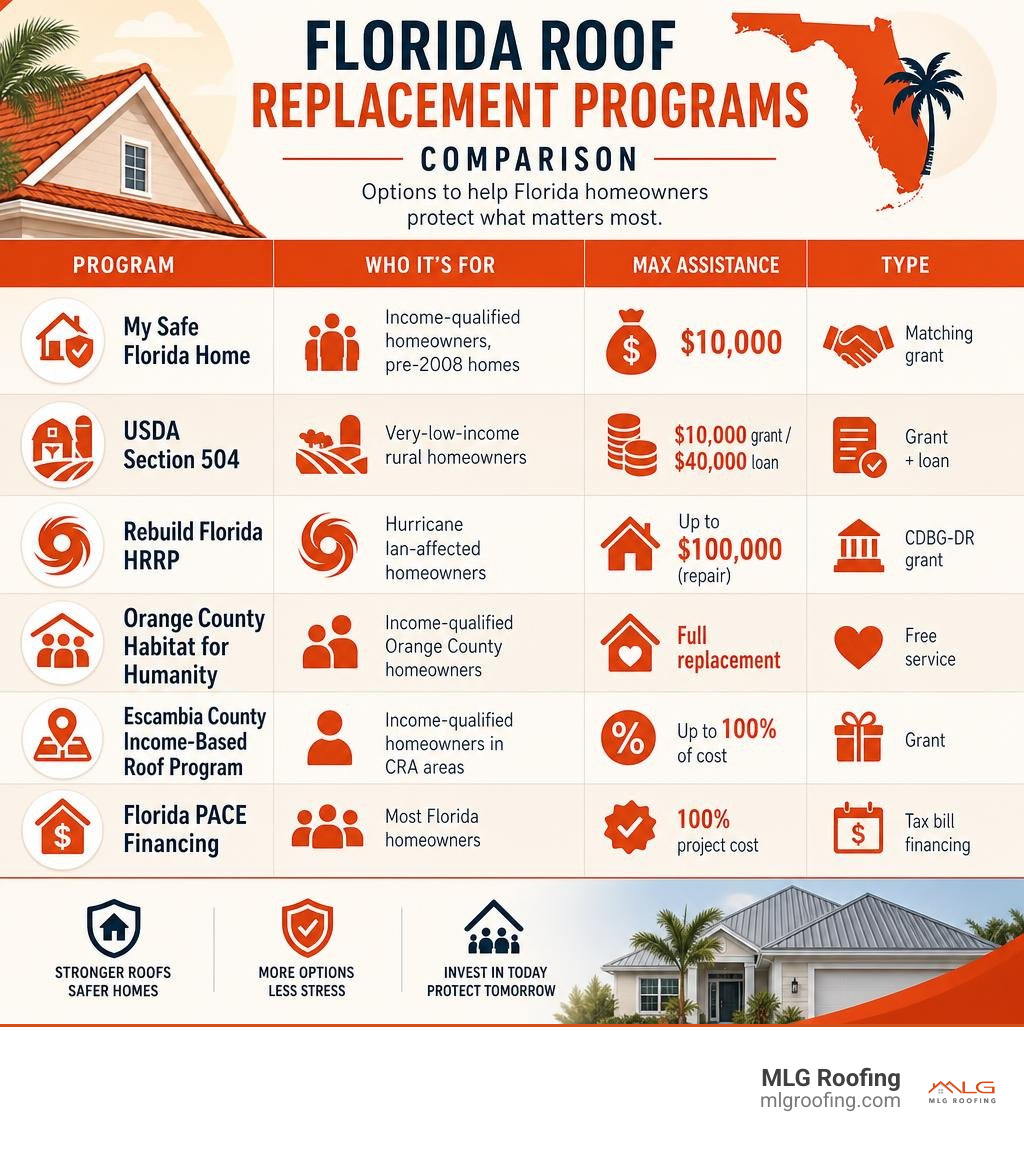
If you’re researching a Florida roof replacement program, here’s a quick overview of common assistance options homeowners may encounter:
Main Florida Roof Replacement and Repair Programs
| Program | Who It’s For | Max Assistance | Type | Repayment Required? |
|---|---|---|---|---|
| My Safe Florida Home | Income-qualified homeowners, pre-2008 homes | Subject to current program limits | Wind mitigation grant | No, if approved as a grant |
| USDA Section 504 Grant | Very-low-income rural homeowners age 62+ who cannot repay a loan | Subject to current program limits | Federal grant | No |
| USDA Section 504 Loan | Very-low-income rural homeowners in eligible rural areas | Subject to current program limits | Federal loan | Yes |
| Rebuild Florida HRRP | Homeowners affected by qualifying disasters | Subject to current program limits | Disaster recovery grant | Usually no, if approved as grant assistance |
| Habitat for Humanity Local Home Preservation Programs | Income-qualified homeowners in communities with participating local chapters | Subject to current program limits | Local nonprofit assistance | Usually no, but verify program terms |
| Escambia County Income-Based Roof Program | Income-qualified homeowners in eligible areas | Subject to current program limits | Local grant assistance | Usually no, but verify program terms |
| Florida PACE Financing | Property owners meeting property-based criteria | Subject to current program limits | Tax assessment financing | Yes |
Local nonprofit assistance programs vary by county. Habitat for Humanity chapters and similar organizations may offer home repair assistance in some Florida communities.
Program availability, funding levels, repayment terms, and eligibility requirements can change over time, so applicants should verify the latest details with the official administering agency before applying.
Many homeowners begin by searching for a Florida roof program, expecting to find one statewide solution. In reality, Florida offers several grants, loans, nonprofit initiatives, disaster recovery programs, and financing options, each with its own eligibility requirements.
Roofs throughout Florida—and especially along the Space Coast—take a beating from salt air, UV exposure, high winds, and hurricane-season weather. For property owners in Brevard County, FL, a failing or damaged roof is not just a maintenance issue. It can affect safety, insurance, energy efficiency, and the ability to protect the home before the next major storm.
The right Florida roof program depends on the home’s location, the applicant’s income, the roof’s condition, whether storm damage is involved, and whether the homeowner needs a grant, loan, or financing option. Knowing the differences between these options can help Florida residents avoid wasting time on programs that do not fit their situation.
This guide explains many of the most common Florida roof replacement programs, grants, loans, financing options, and local assistance resources currently available to eligible homeowners. Because eligibility rules, funding availability, and application periods change over time, homeowners should always confirm current requirements through the agency administering each program.
State-Level Assistance: My Safe Florida Home Wind Mitigation Grants
The My Safe Florida Home Program is one of Florida’s best-known state wind mitigation assistance programs. It is not a general roof replacement program. Instead, it helps eligible Florida residents strengthen qualifying homes against wind damage through approved improvements that may include roof-related work during a replacement project.
For people considering roof replacements in Melbourne, FL, MSFH may help offset certain wind mitigation upgrades when the project meets active program requirements. These improvements can include items such as stronger roof-to-deck attachments, secondary water barriers, opening protection, and other eligible measures identified through the program inspection process.
Applicants should review the official My Safe Florida Home Program portal for the latest application cycle, funding status, and eligible improvement list before making decisions based on grant availability.
Eligibility Requirements for the Florida Roof Replacement Program
To qualify for My Safe Florida Home assistance, a property must meet the program’s eligibility rules. These may include:
- Property type: The home generally must be a site-built, single-family detached residential home or another eligible property type listed by the program.
- Primary residence: Applicants typically need to show that the property is their homesteaded primary residence.
- Construction date: Program rules may consider when the home was originally permitted or built.
- Insurance and property requirements: Dwelling coverage limits, inspection requirements, and other documentation rules may apply.
- Inspection process: Eligible households usually need a program-approved wind mitigation inspection before grant approval and a follow-up inspection after approved work is completed.
Because application requirements can change, those applying should confirm official guidance directly through the state program before starting work.
Grant Amounts and Matching Rules under My Safe Florida Home
The My Safe Florida Home program has historically used a matching-grant structure for many applicants, with separate rules for lower-income homeowners. However, income tiers, funding levels, application windows, and reimbursement rules may change from one cycle to another.
A practical way to evaluate this option is to ask three questions:
- Does the home meet the program’s active eligibility requirements?
- Did the official inspection identify qualifying wind mitigation improvements?
- Can the applicant pay any required share of the project cost before reimbursement, if a match applies?
Does My Safe Florida Home Pay for Roof Replacement?
My Safe Florida Home may help pay for qualifying wind mitigation improvements that are completed as part of a roof replacement, but property owners should not assume it pays for every roof replacement cost. The program is designed around storm-hardening improvements, not general roof replacement for age, wear, leaks, or cosmetic reasons.
For example, someone replacing an older roof may be able to include approved mitigation upgrades during the project if the home and work qualify. The exact amount of assistance depends on available funding, income rules, inspection findings, contractor requirements, and approved scope of work.
Federal and Local Florida Roof Replacement Programs
While state programs can be helpful, federal and local county initiatives may provide additional options for Florida residents who do not qualify for My Safe Florida Home or who need help addressing unsafe housing conditions.
| Program Type | Target Audience | Key Structural Coverage | Funding Mechanism |
|---|---|---|---|
| USDA Section 504 | Very-low-income rural homeowners | Roof repair, safety hazards, structural repairs | Low-interest loan and possible grant assistance |
| Brevard County Rehab | Low-to-moderate income homeowners in Brevard County, FL | Code concerns, failing roofs, emergency repairs | Local housing rehabilitation funding |
| Rebuild Florida HRRP | Homeowners affected by qualifying disasters | Disaster recovery and rebuilding | Federally funded disaster recovery assistance |
USDA Section 504 Home Repair Loans and Grants
The USDA Section 504 Home Repair Program helps very-low-income property owners in eligible rural areas repair, improve, or modernize their homes and remove health and safety hazards. Roof work may qualify when it is needed to make the home safe and livable.
USDA assistance is different from a typical Florida roof program because it is tied to rural property eligibility, household income, ownership requirements, and the applicant’s ability to repay a loan when applicable. Grant eligibility is generally limited to qualifying older homeowners who cannot repay a loan, while loans are repaid over time.
Rural eligibility boundaries may change periodically, so applicants should verify property eligibility using the USDA Property Eligibility Map before applying. They can also contact the USDA Rural Development office serving their area to confirm income limits, application documents, and whether the roof issue fits program guidelines.
Brevard County Replacement, Rehab, and Repair Program
For property owners in Brevard County, local housing rehabilitation programs may help address unsafe conditions, active leaks, code-related problems, or major structural issues. Residents should contact Brevard County Housing and Human Services to verify active repair assistance, eligibility rules, and application steps.
Local rehabilitation funding is dependent on annual budgets, grant allocations, and available program funds. Because available funding is often limited, homeowners should apply as early as possible once an application period opens. Even when a household appears to meet basic criteria, assistance may be limited by waiting lists, inspection priorities, income documentation, and whether the roof condition qualifies under the latest local funding criteria.
For people living on the Space Coast, this kind of local assistance is often most useful when a roof problem creates an immediate habitability or safety concern. A professional inspection can help document roof condition before the applicant contacts the county or local housing office.
Rebuild Florida Housing Repair and Replacement Program
Homeowners affected by qualifying disasters should monitor the Rebuild Florida Housing Repair and Replacement Program for disaster recovery assistance updates, eligibility details, and application windows. Program availability depends on the specific disaster, funding allocation, property location, damage documentation, and active program rules.
Florida Roofing Requirements, Permits, and Insurance Considerations

Florida roofing requirements have evolved over time as the state has updated wind-resistance, permitting, and construction standards. Because of that, repair-versus-replacement decisions should be based on the roof’s actual condition, its permitting history, the current local requirements, and a project-specific evaluation.
Avoid relying on simplified rules of thumb when deciding whether to repair or replace a roof. A small leak, missing shingles, widespread storm damage, aging underlayment, deteriorated decking, or repeated repairs may each point to different next steps. The right answer can also depend on the roofing material, roof slope, prior permits, and what the local building department requires for the proposed scope of work.
A qualified roofing contractor can inspect the roof, document visible damage, explain whether the issue appears repairable, and help the property owner understand what may be required during permitting. The local building department remains the best source for project-specific code and permit guidance.
How Insurance and Code-Required Upgrades May Affect a Roof Replacement
Insurance coverage for roof repair or replacement depends on the cause of damage, the policy language, exclusions, deductibles, roof age provisions, and the insurer’s claim determination. Florida residents should not assume that a policy will automatically pay for a full roof replacement or all code-related upgrades.
If a covered claim requires work that must meet current code, Ordinance or Law coverage may help pay for certain code-required upgrades when that coverage is included in the policy. The Florida Office of Insurance Regulation can be a useful official resource for Florida insurance information, but homeowners should confirm coverage questions directly with their insurance carrier or licensed insurance professional. Without that coverage, the homeowner may be responsible for some upgrade costs even if part of the roof damage is covered.
Before signing a roofing contract tied to an insurance claim, homeowners should review their policy, speak with their insurance carrier or licensed insurance professional, and ask the contractor for a clear written scope of work before signing contracts based on assumed insurance coverage. This helps separate the roofing evaluation from the insurance coverage decision and reduces confusion during the claim process.
Roof Financing in Florida: Is PACE the Right Option?
When grants and local assistance are unavailable, fully obligated, or not a good fit, homeowners may need to compare roof financing in Florida. Financing requires repayment. That means the homeowner repays the project cost over time, either through a tax assessment, loan, credit product, or contractor financing plan. Unlike grant programs, roof financing in Florida requires repayment, so homeowners should compare both the short-term affordability and long-term cost before choosing a financing option.
Property Assessed Clean Energy (PACE) financing is one roof financing Florida option that may allow eligible property owners to finance certain qualifying improvements with no traditional upfront payment. Property owners interested in Florida PACE Financing should review official program information and compare it with other repayment-based options before signing financing documents.
- Tax bill repayment: Instead of a typical monthly bank payment, the financed amount is generally repaid through a special assessment on the property tax bill.
- Property-based approval factors: Qualification may focus on property equity, mortgage status, and property tax payment history rather than only personal credit.
- Sale and refinancing considerations: Because the assessment is tied to the property, applicants should understand how it may affect a future sale, refinance, escrow payment, or mortgage approval.
For those researching roof financing in Florida, PACE is one option alongside home equity loans, traditional personal loans, credit union financing, and contractor financing. The best choice depends on the homeowner’s credit profile, equity, budget, timeline, and comfort with how repayment is structured.
Rather than focusing on national average prices or fixed cost ranges, property owners should compare estimates based on the factors that actually drive roof replacement cost. These include roof size, pitch, accessibility, decking condition, material choice, ventilation needs, tear-off requirements, permit costs, and any wind mitigation upgrades included in the scope.
A professional contractor can provide a written estimate that separates required roof replacement work from optional upgrades and financing-related decisions. That clarity helps eligible households compare a Florida roof replacement program, local assistance, and private financing without treating them as the same thing.
Frequently Asked Questions about Florida Roof Programs
How do I choose the right Florida roof program for my situation?
Start by identifying the type of help you need. If you need money that does not have to be repaid, look first at grant-based programs and local housing assistance. If your home is in a rural area and your income qualifies, USDA Section 504 may be worth reviewing. If the roof issue is tied to a covered storm event, insurance and disaster recovery programs may be relevant. If grants are unavailable or you do not qualify, compare roof financing in Florida, including PACE, home equity options, and contractor financing.
The most useful first steps are to document the roof condition, confirm your household income range, check whether the home is in an eligible area, and contact the agency that administers the program before assuming you qualify.
Can I apply for more than one Florida roof replacement program?
Sometimes. Many homeowners apply for multiple programs to determine which they qualify for, but each program has its own eligibility rules and may restrict combining assistance with other funding sources. Always confirm requirements with the administering agency before beginning work.
Can I get a free roof in Florida?
Some homeowners may qualify for grants, disaster recovery funding, or nonprofit assistance that covers most or all roof replacement costs. However, there is no universal free roof program available in Florida. Eligibility depends on income, location, roof condition, disaster assistance, nonprofit availability, and specific program requirements.
Does My Safe Florida Home pay for roof replacement?
My Safe Florida Home may help with approved wind mitigation improvements that are completed during a roof replacement, but it should not be treated as a general roof replacement grant. Eligibility, approved work, funding availability, and reimbursement rules depend on the application cycle and inspection findings.
What is the income limit for the My Safe Florida Home grant?
The My Safe Florida Home program has used county-specific income tiers based on Area Median Income. However, income limits and eligibility rules can change between program cycles. Applicants should check the official program portal or speak with the administering agency to confirm income thresholds before applying.
Can I combine grants with roof financing in Florida?
Sometimes, but it depends on the program. Some grants may allow homeowners to use financing for the portion of the project not covered by assistance, while other programs may restrict when work can begin, which contractors can be used, or how funds are paid. Before combining a grant with roof financing Florida options, applicants should ask the grant administrator whether outside financing is allowed and whether it affects reimbursement.
Does homeowners insurance cover a full roof replacement?
Insurance coverage depends on the policy, the cause of damage, roof age provisions, exclusions, deductibles, and the claim determination. Ordinance or Law coverage may help with code-required upgrades if it is included in the policy, but property owners should review their policy and speak with their insurance carrier before assuming a full replacement will be covered.
Can condominium associations apply for state roof replacement grants?
Some condominium associations may qualify for state mitigation assistance when a specific condominium program is open and funded. Eligibility can depend on location, association approval, property type, application timing, and active program requirements. Associations should verify program details through official state sources before budgeting around a grant.
Official Resources
Before applying for any Florida roof replacement program, verify rules, funding, and deadlines through the agency or organization that administers the program.
- My Safe Florida Home: State wind mitigation grant information, inspections, and application updates.
- USDA Section 504: Federal home repair loan and grant information for eligible rural homeowners.
- USDA Property Eligibility Map: Property eligibility lookup for USDA rural housing programs.
- Rebuild Florida: Disaster recovery programs for qualifying storm-affected homeowners.
- Brevard County Housing and Human Services: Local housing rehabilitation and repair assistance information.
- Official Florida PACE Program Information: Property-assessed financing details, repayment structure, and eligibility requirements.
- Florida Office of Insurance Regulation: Official Florida insurance information for consumers.
Conclusion
A Florida roof replacement program can be valuable, but the best option depends on the homeowner’s location, income, roof condition, storm history, and whether the available help is a grant, loan, disaster recovery program, local assistance resource, or financing product. Property owners should verify official guidance directly with the administering agency before applying or starting work.
A professional inspection is often the first step toward determining whether repair or replacement is appropriate and whether a homeowner may benefit from available grants, financing, or local assistance programs. MLG Roofing provides professional roof inspections, honest replacement recommendations, and written estimates so homeowners can better evaluate available assistance programs, financing options, and the scope of work before making a decision.