
Types of Interlocking Roof Tiles for Space Coast Homes
The main types of interlocking roof tiles are flat tiles, fluted French and Marseilles profiles, single-piece S-tiles, and ribbed Mangalore tiles. They come in clay and concrete. Each has a different look and drainage pattern, so the right choice depends on roof pitch, weight, and the home’s style.
Interlocking tiles use fitted edges to guide rain down the roof. Their single-lap design can use fewer tiles than traditional plain-tile roofing. For homes in Brevard County, FL, wind resistance also depends on the underlayment and how each tile is fixed, not just its shape. A roofing professional can assess those details before a homeowner chooses a profile.
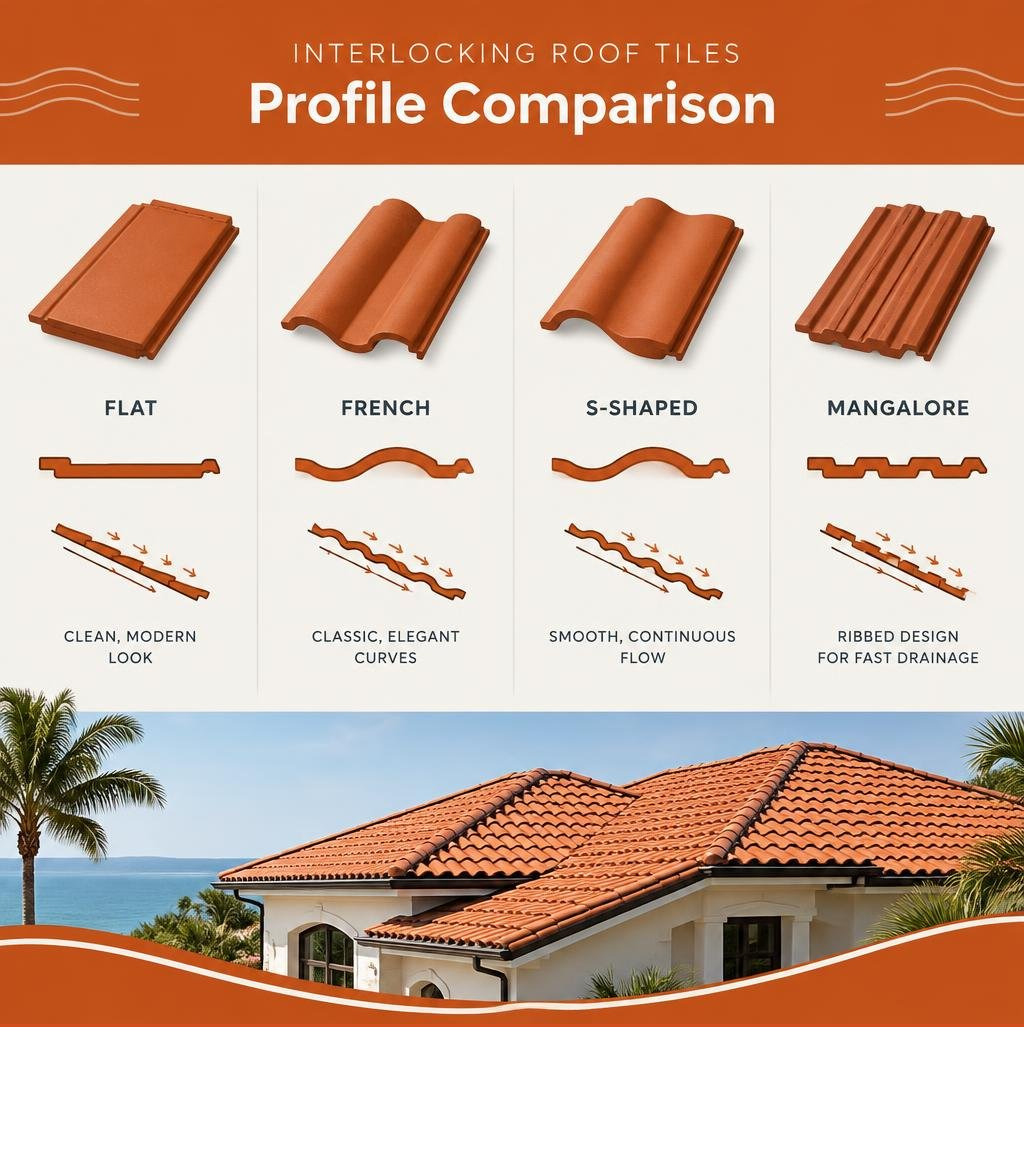
Homeowners considering interlocking clay roof tiles in Brevard County, FL often weigh architectural character against installation speed. Profiles such as double Roman roof tiles and traditional imbrex and tegula systems each bring distinct drainage and visual qualities to Space Coast homes.
Understanding How Interlocking Roof Tiles Work and Why They Outperform Plain Tiles
Interlocking roof tiles date back to the 1840s, making them the most modern category in traditional hard roofing. In 1841, the Gilardoni brothers in France patented the first interlocking clay tile design, revolutionizing the building industry with a mechanical side-lap.
Unlike ancient imbrex and tegula roofing methods or traditional peg tile roof construction which rely on significant overlapping layers (double-lap systems) to prevent leaks, interlocking tiles feature engineered side ribs and head channels. These side ribs and head-and-tail rebates nest together like puzzle pieces.
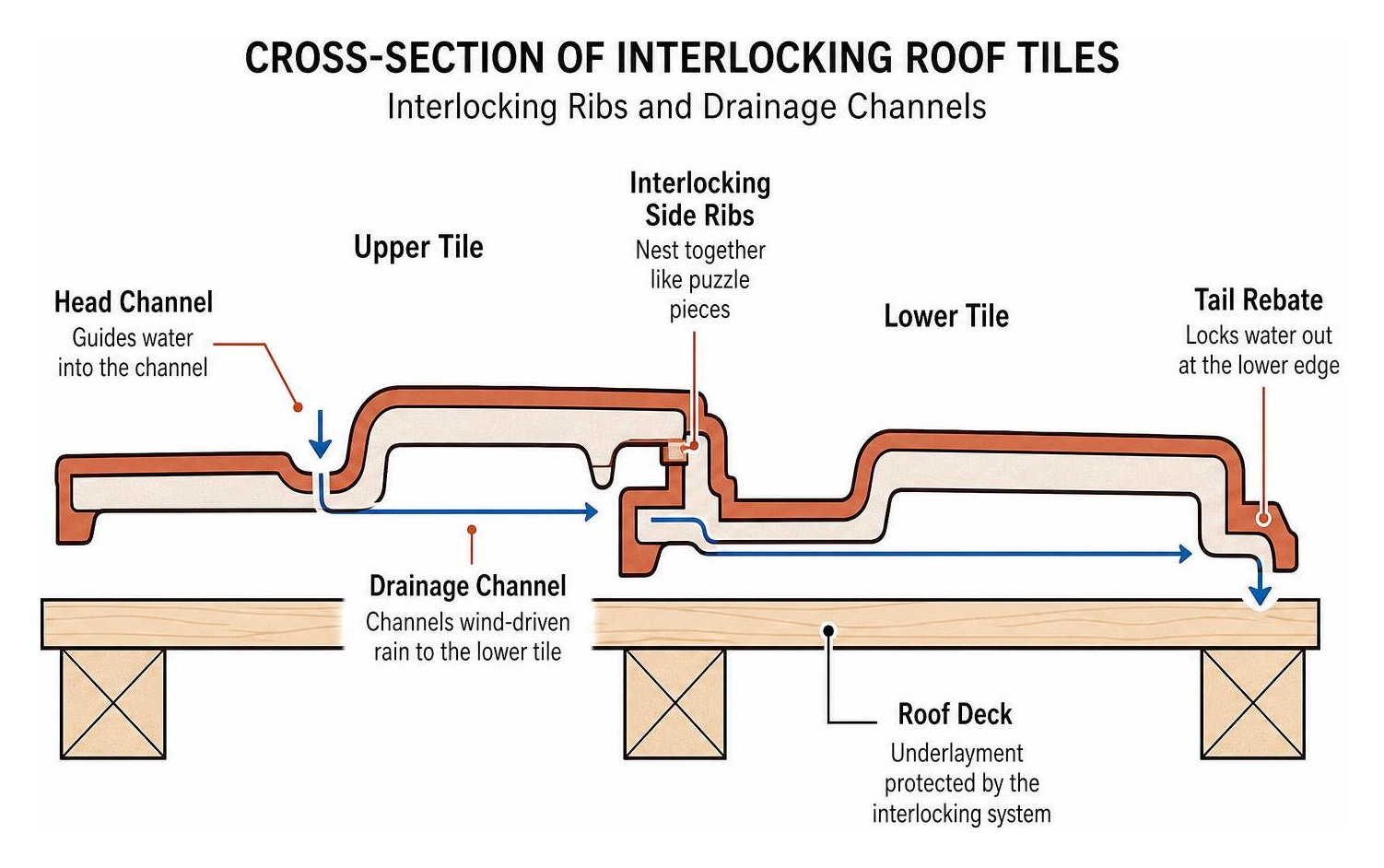
Because the interlocking joints create a continuous water barrier, these units are installed as a single-lap system. This design provides major structural and performance advantages:
- Substantial Weight Reduction: Traditional plain tiles require at least two full layers of coverage over the entire deck. Interlocking designs need only a single layer with minimal overlap, reducing the dead load resting on roof trusses.
- Enhanced Water Drainage: Built-in side channels channel wind-driven rain safely down to the lower tier before moisture can reach the underlayment.
- Faster Installation: Covering more square feet per unit means fewer pieces to carry, align, and fasten.
| Feature | Interlocking Roof Tiles | Traditional Plain Tiles |
|---|---|---|
| System Style | Single-lap (mechanical ribs) | Double-lap (pure gravitational overlap) |
| Average Coverage | ~8 to 11 tiles per square meter | ~50 to 60 tiles per square meter |
| Roof Dead Load | Moderate (approx. 35–58 kg/m²) | Heavy (approx. 70–80+ kg/m²) |
| Minimum Safe Pitch | Down to 17.5°–22° (system dependent) | Typically 35° or steeper |
| Fastener Requirements | Interlocking channels reduce perimeter fixing needs | Every tile or every second course pinned |
Major Interlocking Roof Tiles Types and Profiles for Modern Homes
Roofing manufacturers provide diverse profiles designed to suit specific architectural preferences, runoff rates, and structural layouts. When exploring the architectural elegance of interlocking clay tiles, homeowners will encounter flat, fluted, curved, and complex specialty designs.

Profile Varieties: Flat and Sculptural Interlocking Roof Tiles Types
- Marseilles Design: Developed from early French patents, the Marseilles tile features two deep, indented flutes down its center paired with robust side-locking channels. These center depressions act as water flumes during heavy downpours, moving water off the roof deck quickly.
- French Fluted Tiles: An evolution of classic European patterns, French interlocking profiles offer deep sculptural ridges that produce crisp shadow lines. They bring a distinct, timeless look to coastal properties in Palm Bay and West Melbourne.
- Modern Flat Interlocking Tiles: Sleek, minimalist flat tiles provide crisp horizontal lines favored in modern and transitional architecture. They offer a refined slate-like appearance while locking securely against wind-driven moisture.
- Double Roman Tiles: Featuring a flat base bisected by two rounded rolls, versatile double Roman roof tile styles create gentle, symmetrical water ripples across large roof planes.
- Conosera Turret Profiles: Specifically engineered for conical structures, domes, and rounded roof spires, Conosera profiles interlock on diagonal planes. This allows roofers to seal complex curved spaces without cutting dozens of custom-graduated tiles.
Single-Piece Spanish S-Tiles and Mangalore Varieties
- Single-Piece Spanish S-Tiles: Traditional barrel systems require two separate pieces: a concave pan tile beneath a convex cap tile. Interlocking Spanish S-tiles combine both elements into an integrated “S” shape with a built-in locking flange. Homeowners achieve the classic barrel look with lower material weight and faster installation.
- Mangalore Interlocking Tiles: Popularized in coastal regions facing heavy seasonal rains, Mangalore tiles feature prominent double center ribs and specialized head-and-side water baffles. When comparing premium architectural tile options, Mangalore-inspired profiles stand out for shedding torrential rain on lower slopes, ensuring reliable weather performance across the roof.
Material Breakdown: Interlocking Clay Tiles vs. Interlocking Concrete Tiles
Both clay and concrete serve as reliable materials for interlocking systems, but their physical properties differ significantly under coastal sun, salt air, and storm exposure.
As detailed in the Clay Tile Roofing Technical Guide, natural clay tiles undergo high-temperature kiln firing that vitrifies the raw earth. This creates breaking strengths ranging from 700 to 1,500 pounds and moisture absorption rates often under 2%. Because the earth minerals are baked through, natural clay tiles never fade from UV rays or coastal salt spray.
In contrast, concrete tiles account for nearly half of modern installations due to their cost-effectiveness and impact strength. Modern manufacturing mixes sand, Portland cement, and iron oxide pigments into sturdy profiles. Homeowners weighing concrete tile impact resistance appreciate their resilience against tree debris. However, concrete features roughly 13% porosity, which makes it prone to moisture absorption, surface efflorescence, and color fading over time unless resealed every 3 to 7 years.
| Metric / Specification | Interlocking Fired Clay | Interlocking Concrete |
|---|---|---|
| Material Density & Weight | Moderately heavy (~35–45 kg/m²) | Very heavy (~45–55+ kg/m²) |
| Moisture Absorption Rate | Extremely low (< 1% to 2%) | Moderate to high (~10% to 13%) |
| Color Longevity | Permanent kiln-fired mineral finish | Slurry/pigment surface (may fade) |
| Efflorescence Risk | None | Moderate (calcium salt leaching) |
| Salt Air & UV Resistance | Exceptional | Moderate (requires clear-seal care) |
| Estimated Service Life | 50 to 100+ years | 40 to 60 years (30-year warranty typical) |
Critical Installation Factors: Pitch, Battens, and Specialty Trim
Proper installation is essential for interlocking tiles to perform effectively against wind uplift and water intrusion.
- Roof Pitch Requirements: Standard interlocking profiles operate reliably down to a 22° slope. With specialized sealed-lap underlayments, select profiles can be installed on pitches down to 17.5°. Low-pitch assemblies require specialized self-adhering modified bitumen underlayment to guard against wind-driven moisture.
- Batten Layout and Ventilation: Tiles are hung from horizontal wooden or composite battens spaced to match the tile gauge. Proper spacing maintains an open air space beneath the tiles, venting heat away from the roof deck and lowering indoor attic temperatures.
- Specialty Fittings and Trim: A complete interlocking roof system relies on factory-molded accessory pieces. Dry-fix ridge caps, hip starters, valley flashings, and ventilated eave starters seal critical intersections without relying heavily on mortar beds, which can crack over time.
Because extreme heat and wind storms can stress roof assemblies, scheduling regular professional tile roof inspections ensures that interlocking tabs remain aligned and sealants stay intact throughout the life of the roof.
Key Differences: Interlocking Roof Tiles Types vs. Traditional Barrel Tiles
- Fastener Reduction: Interlocking channels hold adjacent tiles firmly together, reducing the total fastener count needed compared to loose cap-and-pan barrel assemblies.
- Labor Efficiency: A single installer covers more roof area per hour because interlocking joints establish consistent courses and vertical alignment automatically.
- Reduced Structural Framing Demands: By cutting the total tile count by up to 40% compared to two-piece barrel installations, interlocking profiles reduce structural framing reinforcement needs.
Frequently Asked Questions About Interlocking Roof Tiles
What is the minimum roof pitch required for interlocking roof tiles?
Most standard interlocking tile systems require a minimum roof pitch between 20° and 22° (approx. 4:12 to 4.5:12). However, certain modern profiles featuring deep anti-capillary ribs can be installed on slopes down to 17.5° or 15°, provided they are installed over a fully waterproof, self-adhered underlayment system approved by local building departments.
How long do interlocking clay and concrete tiles typically last?
Fired-clay interlocking tiles routinely last 50 to 100 years or more, retaining their original coloration. Concrete interlocking tiles typically provide 40 to 60 years of service. Concrete tiles benefit from periodic washing and resealing every 3 to 7 years to minimize moisture absorption and keep colors looking vibrant.
Can interlocking roof tiles withstand hurricane-force winds?
Yes, when installed with proper mechanical fastenings and high-adhesion underlayment. The interlocking side channels distribute uplift forces across neighboring tiles rather than concentrating stress on individual fasteners. In coastal communities across Rockledge, Viera, and Merritt Island, building codes require approved fastener or adhesive patterns to ensure maximum wind resistance.
Conclusion
Interlocking roof tiles combine historic craftsmanship with engineered moisture control. Whether a property calls for the crisp lines of modern flat tiles, the drainage of Marseilles profiles, or the classic silhouette of single-piece Spanish S-tiles, interlocking profiles offer a balance of weather resistance and installation efficiency.
For homeowners in Brevard County, FL exploring their roofing options, choosing the right material depends on structural load limits, neighborhood architectural guidelines, and project budgets. While interlocking tile systems offer classic appeal, many Space Coast homeowners also choose long-lasting metal roofing or high-performance asphalt architectural shingles.
MLG Roofing provides expert residential roof replacement, leak detection, storm damage repair, and emergency tarping across Melbourne, Palm Bay, Rockledge, Cocoa, and Sebastian. Whether you need a comprehensive roof inspection or are evaluating a full system replacement, our team delivers dependable solutions tailored to coastal Florida weather. Contact MLG Roofing today to schedule your on-site evaluation.