
Engineering Metal Roof Hurricane Protection: Wind Uplift, Design Pressure, and Aerodynamics
Metal roofs provide hurricane protection against wind uplift through a continuous load path: mechanical-lock seams, concealed clips, sealed underlayments, and tight perimeter fastening transfer suction forces from the panel into the roof deck and structural framing. For homeowners across Brevard County, FL and the Space Coast, this engineered assembly is what keeps a roof intact when high-velocity winds move over the eaves and ridges. As wind travels across the exterior envelope of a home, it is forced up and over the roof, creating an aerodynamic effect much like an airplane wing: fast-moving air across the top reduces atmospheric pressure, while higher pressure remains inside the attic and beneath the roof plane. The resulting suction force, known as negative wind uplift, attempts to pull the roof covering upward and away from the building.
Engineering a roof to withstand severe coastal conditions requires understanding design wind pressure, measured in pounds per square foot (psf). The engineering calculations governing roof construction follow rigorous standards, including ASCE 7-22 wind load criteria. These calculations divide a residential roof into three distinct aerodynamic zones:
- Zone 1 (Field): The central, flat expanses of the roof where uplift forces are the lowest.
- Zone 2 (Perimeter/Edges): The areas along eaves, rakes, and ridges where air separates and accelerates, generating significant localized suction.
- Zone 3 (Corners): The intersection points where powerful corner vortices form, creating the highest negative uplift pressures on the entire structure.
Because corners and perimeters experience dramatically higher aerodynamic forces, a roof covering cannot rely on a uniform fastening schedule across the entire surface. Selecting how to choose the best roof material for Florida weather requires balancing structural load transfer and panel deflection. When wind pulls upward on a metal panel, that uplift load must transfer cleanly through the seam, into the clips or fasteners, down to the roof decking, and ultimately into the structural framing of the home.
If panel deflection is excessive or if fastener pull-out resistance is inadequate, the panel separates from the substrate, compromising the entire building envelope.
Real-World Storm Performance: Standing Seam vs. Exposed Fasteners
While laboratory testing provides baseline design values, real-world hurricane events reveal stark differences between panel designs. Forensic engineering reports conducted across Florida and the broader Gulf Coast consistently illustrate that all metal roofs do not perform identically in extreme wind environments.
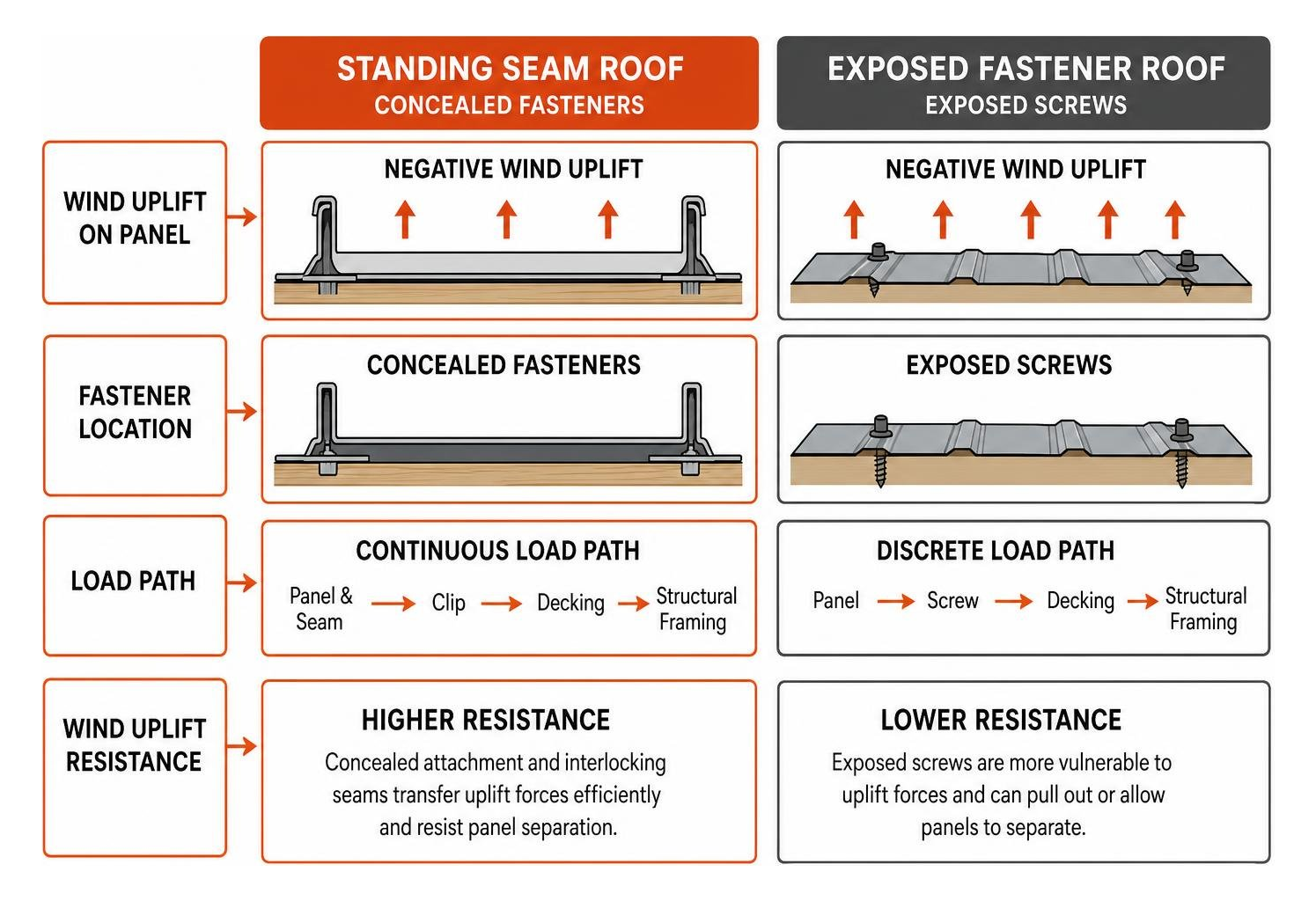
Standing Seam vs. Exposed Fasteners for Metal Roof Hurricane Protection
The fundamental division in residential metal roofing lies between standing seam systems and exposed-fastener systems (such as 5V-crimp, R-panels, or corrugated profiles).
Standing seam panels utilize concealed fasteners and clips hidden beneath continuous raised interlocking seams. This profile eliminates exposed screw holes in the weather-facing surface and allows the metal to expand and contract naturally through seasonal temperature fluctuations without placing cyclic stress on fastener penetrations. High-performance standing seam systems commonly utilize heavy-gauge metal (such as 24-gauge steel or thick-gauge aluminum) and structural mechanical-lock seams folded tightly along the panel seams.
In contrast, exposed-fastener systems rely on screws driven directly through the face of the metal panel into the roof deck, sealed with neoprene or EPDM rubber washers. While economical, these systems present several critical vulnerabilities during high-wind events:
- Washer Degradation: Intense Florida ultraviolet radiation degrades rubber washers over 10 to 15 years, leading to embrittlement, cracking, and water infiltration points.
- Cyclic Fatigue & Screw Back-Out: Thermal expansion forces thin panels (often 29-gauge) to push and pull against static fasteners, wallowing out screw holes and weakening fastener pull-out resistance.
- Surface Vulnerability: Thousands of exterior penetrations provide thousands of potential failure points under wind-driven hydrostatic pressure.
For maximum storm durability, working with a qualified contractor following proven standing seam roofing installation guidelines ensures the roof system transfers wind forces directly into the structure without surface penetrations.
| Roofing System Type | Typical Gauge / Thickness | Fastener Concealment | Typical Uplift Threshold | Debris / Impact Resistance | Expected Coastal Lifespan |
|---|---|---|---|---|---|
| Mechanical-Lock Standing Seam | 24-ga. Steel / 0.032″–0.040″ Aluminum | Fully Concealed Clip Assembly | 150 to 180+ mph (Up to -198+ psf) | High (UL 2218 Class 4) | 40 to 70 Years |
| Snap-Lock Standing Seam | 24–26 ga. Steel / 0.032″ Aluminum | Concealed Clips or Fastener Flange | 120 to 140 mph (Up to -120 psf) | High (UL 2218 Class 4) | 40 to 50 Years |
| Exposed Fastener (5V-Crimp / Corrugated) | 26–29 ga. Steel | Exposed Screws with Rubber Washers | 80 to 110 mph (Wide screw spacing) | Moderate (Prone to washer tear-out) | 15 to 25 Years (Washer life) |
| Standard Architectural Shingles | Multi-layer Asphalt Composition | Concealed Roofing Nails | 110 to 130 mph (When newly installed) | Moderate (Granule loss / tearing) | 15 to 20 Years |
Lessons from Recent Major Hurricanes
Post-storm damage surveys from events such as Hurricane Michael, Hurricane Sally, and Hurricane Ida provide invaluable field data on structural survivability:
- Hurricane Michael (Category 5): In areas experiencing sustained winds above 150 mph, mechanical-lock standing seam roofs demonstrated superior survival rates compared to standard residential roof types. Conversely, exposed-fastener roofs with wide screw spacing frequently suffered progressive panel peel-off once edge attachments failed.
- Hurricane Sally (Category 2): Sally produced exceptional volumes of wind-driven rain. Field assessments showed that while many exposed-fastener roofs remained attached to the decking, degraded neoprene washers allowed extensive interior water intrusion at thousands of screw penetrations.
- Hurricane Ida (Category 4): Post-storm forensic evaluations highlighted that structural losses rarely began in the center of the roof field; rather, failure almost exclusively originated at poorly secured perimeter edge flashing.
According to comprehensive field data on metal roof hurricane performance, progressive edge detachment remains the leading cause of catastrophic panel unzipping during tropical storm systems.
High-Wind Standards and Certifications: FORTIFIED, Miami-Dade NOA, and Florida Building Code
To ensure a roof system withstands severe storm conditions, materials and assemblies must be certified through standardized structural testing.

Navigating Design Pressure (DP) and Coastal Wind Ratings
Roof systems in Florida undergo rigorous testing to determine their Maximum Design Pressure (MDP). Laboratory standards—such as ASTM E1592 (for structural metal panel uplift), UL 580 (uplift resistance of roof assemblies), and TAS testing protocols—simulate severe uplift loads.
In high-wind coastal jurisdictions, assemblies must hold valid Florida Product Approval standards for high-wind zones or Miami-Dade Notices of Acceptance (NOA). These engineering evaluations specify the precise assembly configuration:
- Allowable panel widths and metal alloy thicknesses.
- Specific clip models (such as two-piece expansion clips or heavy-duty fixed butterfly clips).
- Fastener schedules, dictating screw types, embedment depths, and clip spacing intervals (e.g., 6, 12, or 24 inches on center) required to achieve certified negative uplift ratings ranging from -78 psf to over -200 psf.
Flashing, Deck Attachment, and Sealed Underlayment Requirements
A metal panel is only as strong as the deck it is fastened to. The Insurance Institute for Business & Home Safety (IBHS) administers the FORTIFIED Home™ standard, which focuses on eliminating common building envelope failure points.
Following the FORTIFIED Home™ guidance on metal panel roof coverings requires a multi-layered defense strategy:
- Enhanced Deck Fastening: Plywood roof decks (typically 19/32-inch minimum for high-wind installations) must be attached to roof trusses using 8d ring-shank nails with tight spacing schedules to prevent structural deck pull-off.
- Sealed Roof Deck: Installing a continuous, high-temperature self-adhering (peel-and-stick) underlayment directly to the wood deck creates a secondary water barrier. If panels are damaged or displaced, the sealed deck keeps wind-driven rain out of the home.
- Rigid Perimeter Detailing: Drip edges and rake metal must be fabricated from heavy-gauge, non-corrosive metal, fastened with staggered ring-shank nails or screws at 4- to 6-inch centers, and bedded in high-performance structural adhesive.
When evaluating whether metal roofs are good in Florida, this layered system design delivers superior protection compared to standalone surface coverings, ensuring lasting security during coastal storms.
Metal Roofing vs. Traditional Shingles in Severe Coastal Weather
Evaluating long-term storm resilience involves comparing structural behavior under severe wind, airborne debris, and environmental exposure.

Impact Resistance, Class 4 Ratings, and Wind-Driven Rain Defense
During tropical storms, airborne debris—including tree limbs, severed shingles, and dislodged construction materials—poses a major hazard. Premium metal roofing profiles regularly achieve a UL 2218 Class 4 impact rating, the highest classification available for roofing materials.
While heavy debris impacts can cause cosmetic indentations on metal, the material resists cracking, puncturing, or fracturing. Asphalt shingles, by comparison, often suffer granule loss, substrate cracking, or complete tab tear-off under similar impacts, leaving the wood deck exposed to rain. Furthermore, interlocking metal panel seams shed high-volume rainfall efficiently and withstand intense horizontal hydrostatic pressures that can lift standard shingle tabs.
Salt-Air Corrosion and Long-Term Lifespan Considerations
For coastal structures in communities like Satellite Beach, Cocoa Beach, Indian Harbour Beach, and Merritt Island, storm durability is intertwined with corrosion resistance. Constant exposure to marine salt spray can rapidly degrade unprotected metal components.
Homeowners can maintain longevity by understanding methods for protecting coastal roofs from salt air corrosion. Choosing the right substrate and finish is essential:
- Zinc-Aluminum Alloy-Coated Steel (AZ50/AZ55): Offers excellent durability for inland and moderate coastal exposures, typically finished with advanced polyvinylidene fluoride (PVDF) resin coatings.
- Marine-Grade Aluminum (0.032″–0.040″): The standard recommendation for immediate oceanfront properties, aluminum naturally resists saltwater oxidation and prevents galvanic corrosion.
While the initial metal roofing cost across Florida is higher than traditional asphalt shingles, a properly engineered metal roof provides an expected service life of 40 to 70 years, often outlasting multiple shingle replacements in coastal environments.
Maintenance and Professional Verification for Storm-Readiness
Even the most robust roofing system requires periodic verification to ensure its wind uplift engineering remains uncompromised over decades of coastal weather.
Critical Inspection Checklist to Maintain Metal Roof Hurricane Protection
Property owners can maintain storm readiness by scheduling routine professional evaluations before each hurricane season. Key inspection focal points include:
- Perimeter Edge & Rake Flashing: Verifying that drip edges, eaves, and gable flashings remain securely anchored without loose screws or separated lap joints.
- Fastener & Washer Integrity: On exposed-fastener roofs, inspecting neoprene washers for UV embrittlement, overtightening deformation, or back-out, replacing worn fasteners promptly.
- Panel Seam Engagement: Inspecting mechanical locks and snap seams to ensure thermal movement has not loosened clip engagements.
- Ridge Caps & Vent Detailing: Checking ridge caps, z-furring strips, and ventilation exhaust points for tight sealant bonds and solid structural anchoring.
- Drainage Pathways & Valleys: Clearing accumulated leaves and debris from valleys to prevent water ponding during intense downpours.
If severe weather impacts the area, homeowners should rely on a systematic approach for identifying post-storm roof damage rather than attempting dangerous roof walks.
Essential Questions to Ask Your Roofing Contractor Before Installation
When selecting a roofing professional, homeowners should verify technical competence and engineering compliance by asking:
- What specific Florida Product Approval or NOA number will be used for this metal roof assembly?
- What is the maximum design uplift pressure (in psf) for Zone 1, Zone 2, and Zone 3 on my specific roof geometry?
- What clip type and clip spacing schedule will be used along the perimeter eaves, rakes, and corners?
- What underlayment system is included, and is it a direct-to-deck high-temperature self-adhering secondary water barrier?
- What fasteners are specified for attaching the drip edge metal, and what is the fastening schedule?
- Is your installation crew factory-certified or specifically trained in mechanical seaming equipment?
Frequently Asked Questions About Metal Roof Wind Resistance
Can a metal roof withstand a Category 5 hurricane?
Yes, properly engineered and installed metal roofing systems can withstand Category 5 hurricane conditions (winds exceeding 157 mph). Systems utilizing heavy-gauge steel or aluminum, mechanical-lock seams (180-degree or 360-degree double locks), tight clip spacing (often 6 to 12 inches on center along perimeters), and continuous ring-shank deck nailing regularly achieve certified wind resistance exceeding 160 to 180 mph. However, survival also requires that the underlying roof trusses and wall framing remain structurally intact.
What is the most common point of failure for metal roofs in high winds?
The single most common point of failure is perimeter edge metal detailing—specifically rake flashing, drip edges, and eave starters. When edge metal is inadequately fastened or improperly sealed, high-pressure corner vortices get underneath the metal, pulling the trim upward. Once the perimeter releases, wind gets beneath the primary metal panels, initiating a progressive peeling or “unzipping” effect across the roof plane.
How does wind uplift pressure differ from nominal wind speed ratings?
Nominal wind speed (measured in mph) describes the velocity of moving air in an open environment. Wind uplift pressure (measured in pounds per square foot, psf) quantifies the actual suction force exerted on a building’s specific roof surfaces. Uplift pressure accounts for building height, roof pitch, terrain exposure, building geometry, and localized corner vortices. Two buildings experiencing the exact same 140 mph wind speed can experience vastly different uplift pressures depending on their architectural profile.
Conclusion
Securing dependable hurricane resilience for a coastal home requires looking beyond the surface material. True storm protection is the result of a fully integrated, engineered assembly where high-gauge panels, concealed structural clips, heavy-duty perimeter flashings, ring-shank deck attachments, and sealed self-adhering underlayments work as a unified barrier against severe uplift and wind-driven rain.
When planning a roof replacement or evaluating existing storm readiness, partnering with an experienced, locally licensed contractor ensures every component is installed to meet stringent Florida standards. For homeowners across Melbourne, Palm Bay, West Melbourne, Rockledge, Viera, Merritt Island, Cocoa, and Sebastian, MLG Roofing provides comprehensive inspections, code-compliant installations, and dedicated storm damage solutions. Explore engineered protection tailored to your home by visiting our professional metal roofing services page or scheduling an evaluation before the next storm season arrives.