
The Common Question Every Brevard County Homeowner Asks Before Roof Day
Should you stay home during a roof replacement? Yes, you can stay in your home throughout the entire process — but whether you should depends on your personal situation.
At MLG Roofing, one of the questions we hear most often before installation day is whether homeowners need to leave the house. The answer depends far more on your comfort level than on safety. Our crews work on occupied homes every week throughout Brevard County, and with proper preparation, most homeowners can safely remain in their homes during the project.
What Most Homeowners Actually Do During Roof Replacement
In our experience replacing roofs throughout Brevard County, most homeowners stay home for at least part of the project. Some leave for the first tear-off day because it is the loudest phase, while others continue their normal routine and simply avoid the work area. Families with infants, anxious pets, or people working from home often choose to spend the day elsewhere before returning once the crew finishes for the day.
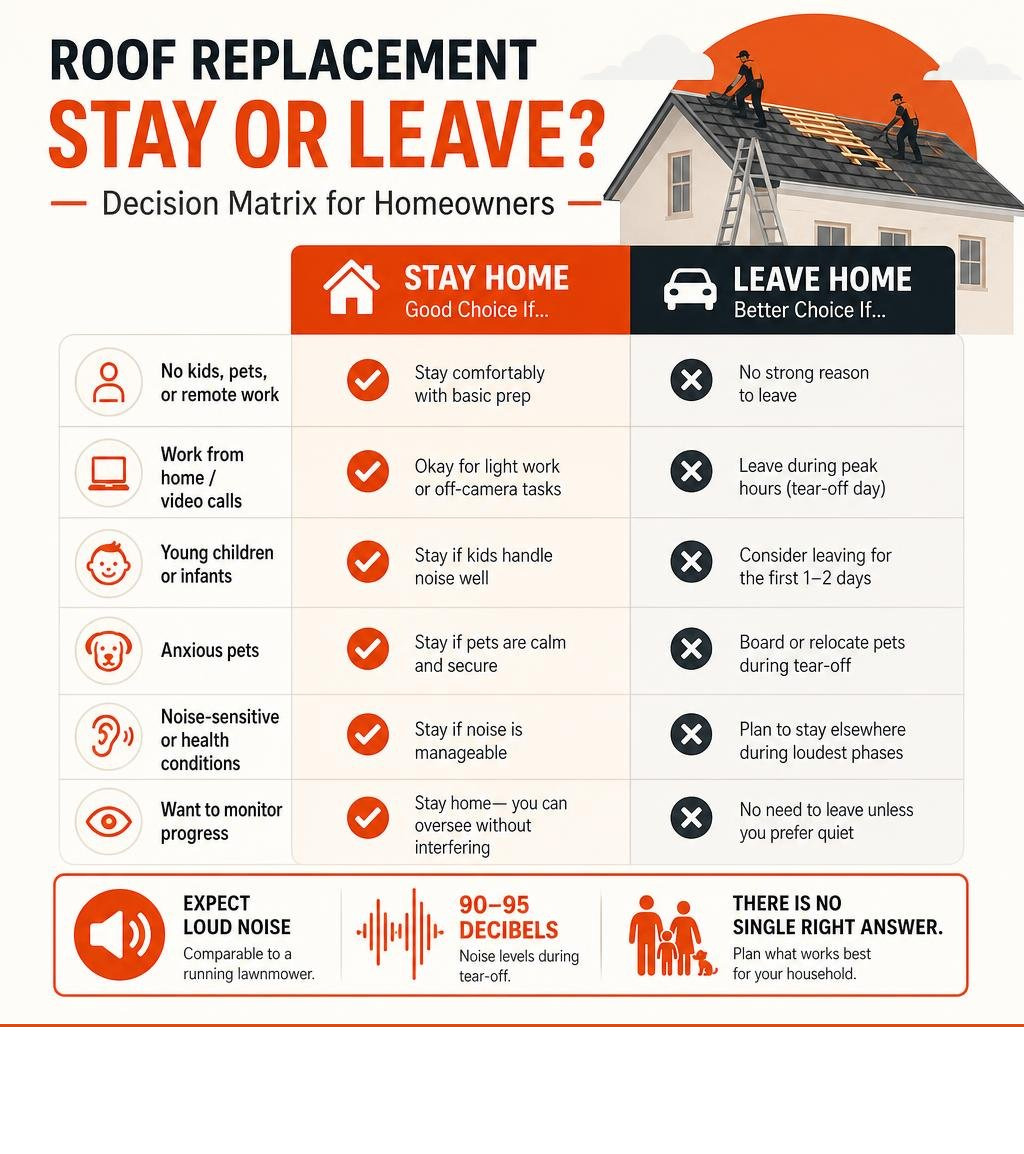
Here is a quick answer based on the most common homeowner circumstances:
| Your Situation | Recommended Approach |
|---|---|
| No kids, pets, or remote work | Stay home comfortably with basic prep |
| Work from home / video calls | Leave during peak hours (tear-off day) |
| Young children or infants | Consider leaving for the first 1–2 days |
| Anxious pets | Board or relocate pets during tear-off |
| Noise-sensitive or health conditions | Plan to stay elsewhere during loudest phases |
| Want to monitor progress | Stay home — you can oversee without interfering |
Most homeowners on Florida’s Space Coast choose to stay home, but many choose to step out during the loudest tear-off phase. That is completely reasonable. Roof replacement noise can reach levels comparable to a running lawnmower. The CDC recommends limiting prolonged exposure to loud noise, taking breaks, and using hearing protection when appropriate.
The good news: there is no single right answer. Every household is different, and the best decision depends on your work schedule, family, pets, health considerations, and comfort with construction noise. Understanding what to expect makes the decision much easier, and a little preparation goes a long way toward keeping your household comfortable and your property protected throughout the project. If you are researching local options, start by comparing roofing companies in Brevard County. You can also review MLG Roofing’s guide to the Florida roof replacement program or follow this step-by-step guide to home roof replacement to better understand the process before installation day.
Should I Stay Home During Roof Replacement? Pros and Cons
Deciding whether to stay or go during a major home improvement project involves balancing convenience, budget, and peace of mind. While staying home allows homeowners to keep an eye on the progress, leaving offers a quiet escape from the construction zone.
The table below outlines the primary trade-offs of staying on-site versus finding temporary accommodations:
| Factor | Staying Home | Leaving the Property |
|---|---|---|
| Oversight | High; immediate access to the project manager | Low; updates are received via phone or email |
| Cost | Free; no hotel, coworking, or boarding fees | Higher; requires budgeting for temporary lodging |
| Noise & Disruption | High; constant hammering, scraping, and vibration | None; complete escape from the daily construction chaos |
| Safety Risks | Moderate; must navigate active work zones and debris | Low; completely avoids the active jobsite |
| Daily Routine | Disrupted; limited driveway access and indoor privacy | Maintained; routines can continue in a quiet environment |
Regardless of the choice, safety must remain the absolute priority. For those who decide to stay, establishing strict safety guidelines is essential. Homeowners must stay clear of the active work zone, which typically extends a safe distance around the perimeter of the house. Walking under the eaves or near roof edges during active construction is dangerous due to the risk of falling shingles, underlayment scraps, and stray nails. OSHA’s residential construction fall-protection guidance also underscores why roofing work requires controlled access, fall protection, and clear separation from hazardous areas.
Pros of Remaining on the Property
One of the greatest benefits of staying home is the ability to make real-time decisions. During a roof replacement on the Space Coast, unexpected issues can arise once the old shingles are removed. For instance, the crew might discover rotted roof decking caused by a previous slow leak. If the homeowner is present, they can inspect the damage and approve the necessary repairs immediately, keeping the project on schedule.
Staying on-site also makes budget monitoring more straightforward. Homeowners can discuss any unexpected structural findings directly with the project manager and review the scope of work before extra materials are ordered. Additionally, remaining home provides enhanced property security and allows for direct, face-to-face contractor communication, which can prevent misunderstandings.
Cons of Remaining on the Property
The most significant drawback of staying home is the extreme noise. With crew members walking overhead, scraping off old materials, and using pneumatic nail guns, the sound levels inside the house can easily reach high levels. This constant noise makes concentration nearly impossible, which is a major hurdle for anyone trying to work or study from home.
Vibration risks are another concern. The heavy impact of hammering on the roof deck sends vibrations down through the framing of the house. These vibrations can cause drywall dust to sift down from attic spaces and can even rattle fragile items off shelves or walls. Finally, dust and debris will naturally accumulate around the property, and limited driveway access can make running quick errands highly inconvenient.
Choosing a Reputable Space Coast Contractor
To minimize the stress and disruption of a roof replacement, it is crucial to work with a highly qualified local professional. Homeowners in Melbourne and surrounding Space Coast communities should look for contractors with deep local roots and recognized industry credentials. Working with a manufacturer-certified roofer ensures that the installation meets rigorous quality standards and qualifies for enhanced warranty protection.
A reputable contractor will handle all local permitting requirements, coordinate material deliveries efficiently, and provide clear timelines. For those planning a project in Brevard County, MLG Roofing’s guide to professional roofers in Melbourne, FL can provide valuable insights into selecting a team that prioritizes both workmanship and customer comfort.
Final Verdict: Should I Stay Home During Roof Replacement?
The decision should come down to personal comfort, work-from-home needs, and the health conditions of the residents. If the household includes night-shift workers who need daytime sleep, individuals with sensory sensitivities, or family members recovering from medical procedures, temporary relocation is highly recommended.
For those who decide to stay, coordinating closely with the project manager is key. Sharing contact information, discussing daily work hours, and establishing clear lines of communication will help ensure a smooth, successful project with minimal surprises.
Noise, Vibrations, and Timeline Expectations
Understanding what actually happens on the roof day-to-day can help homeowners prepare mentally and physically for the project. A roof replacement is a highly physical, industrial process that transforms the home into an active construction site.
The loudest and most disruptive phase is the tear-off process, which typically takes up the first day or two. During this stage, the crew uses specialized shovels and pry bars to tear away layers of old shingles, underlayment, and flashing, tossing them down into a designated dumpster. The scraping, banging, and sliding of heavy debris can be incredibly loud.
Once the deck is prepped, the nail gun installation begins. While less chaotic than the tear-off phase, the rhythmic, high-velocity thud of pneumatic nail guns continues throughout the day. Homeowners should also prepare for vibration damage. The repeated impact on the roof can cause loose items on interior walls, like picture frames, mirrors, and decorative plates, to shift or fall. Dust from the attic can also sift through ceiling light fixtures, so covering valuables in upper-floor rooms is a wise precaution.
To get a better sense of the daily activity and sounds, homeowners can watch a short video that explains whether you should stay home during a roof replacement.
Understanding the Roof Replacement Timeline
A typical residential roof replacement on the Space Coast often takes a few days to complete, but some simple roofs may be finished in one day while larger or more complex projects can take longer. The exact timeline depends on several factors:
- Roof Size and Complexity: Larger homes or those with steep slopes, multiple valleys, and complex architectural features require more time and detail work.
- Florida Weather Delays: Rain, lightning, and high winds can pause work instantly. Local crews monitor coastal weather patterns closely to ensure the roof is never left exposed to a sudden afternoon downpour.
- Material Choice: Standard asphalt shingle installations are generally faster, whereas metal roofing systems require specialized handling and precise layout, which can extend the timeline.
A roof replacement usually moves through these main phases:
| Phase | What Happens |
|---|---|
| Tear-off | Old shingles, underlayment, flashing, and damaged materials are removed from the roof. |
| Deck inspection & repairs | The crew checks the roof deck for rot, soft spots, or damaged sheathing and makes needed repairs before covering it. |
| Underlayment & installation | New underlayment, flashing, drip edge, vents, and roofing materials are installed according to the project scope. |
| Cleanup & final inspection | The crew removes debris, performs magnetic nail sweeps, checks the finished roof, and reviews final details. |
For a detailed breakdown of what happens during each phase of the installation, homeowners can explore MLG Roofing’s step-by-step guide to home roof replacement.
Will Roofers Need to Come Inside Your Home?
In almost all cases, a roof replacement is an entirely exterior project. The crew will spend their time on the roof and around the perimeter of the yard. However, there are a few specific reasons why a contractor might need brief interior access:
- Attic Inspections: The project manager may need to inspect the attic space to check the underside of the roof decking, verify proper ventilation, or ensure that bathroom and kitchen exhaust vents are correctly connected to the roof caps.
- Ventilation Checks: Ensuring proper airflow is critical for meeting local building codes and validating manufacturer warranties.
- Interior Ceiling Leaks: If the home has active water damage, the contractor may need to look at the interior ceilings to trace the source of the leak and ensure the structural integrity of the underlying framing.
Safety and Property Protection: Managing Children, Pets, and Mess

A professional roofing site is carefully managed, but it still presents hazards. Falling debris, stray nails, and heavy equipment are part of the daily environment. Homeowners must prioritize the safety of vulnerable family members, including young children and elderly residents, who may struggle with the sudden changes to their physical environment or disrupted schedules. Children should also be reminded not to collect roofing materials or explore around dumpsters or material piles, even after the crew has finished for the day.
Contractors take extensive precautions, such as setting up safety perimeters and using tarps to catch falling shingles. At the end of each workday, the crew will perform magnetic sweeps of the lawn, driveway, and walkways to collect dropped nails. However, because nails can bounce off roof edges or hide in the grass, homeowners should remain cautious and wear closed-toe shoes when walking outside.
Deciding Factor: Should I Stay Home During Roof Replacement with Pets?
For households with pets, the noise and presence of strangers on the roof can be incredibly stressful. The constant hammering sounds like a non-stop thunderstorm directly overhead. Dogs may bark continuously, and cats often hide in hard-to-reach places out of fear.
To keep pets safe and calm, homeowners have a few options:
- Boarding Facilities or Doggie Daycare: Relocating pets for the initial phase of the project is often the best way to prevent severe anxiety.
- Safe Interior Zones: If pets must stay home, place them in a quiet, interior room on the lowest level of the house, far away from exterior walls. Turn on a television, radio, or white noise machine to help drown out the construction noise.
- Checking Paws: If pets go outside in the yard after hours, always check their paws for stray nails or small debris that might have been missed during the initial cleanup.
How to Prepare Your Home Before Installation Day
Taking a few hours to prepare the home before the crew arrives can prevent minor damage and reduce stress. Inside the home, the main goal is to protect belongings from vibrations. Homeowners should remove valuable wall art, secure fragile glass items on shelves, and cover storage items in the attic with plastic sheeting to protect them from falling dust.
Outside, the yard should be cleared of any obstacles. Moving lawn ornaments, potted plants, and toys away from the house ensures the crew has a clear path and prevents accidental damage. For a complete checklist, review MLG Roofing’s guide on how to prepare your home for a roof replacement.
Driveway Logistics: Parking, Vehicles, and Outdoor Furniture
Driveway access will be highly restricted during a roof replacement. Roofing companies use heavy trucks to deliver materials and often park a large dumpster in the driveway to collect old shingles.
To avoid getting blocked in, homeowners should move all personal vehicles to the street the night before work begins. This also protects cars from any falling debris or stray nails. Additionally, patio furniture, grills, and trampolines should be moved a safe distance away from the home’s perimeter or stored in a garage to keep them safe and out of the crew’s active work zones.
Frequently Asked Questions about Roof Replacement Logistics
Can I run my AC during a roof replacement?
Many roofing contractors recommend turning off the outdoor AC unit during the tear-off phase of the project. The removal of old roofing materials creates a significant amount of airborne dust, fiberglass particles, and small debris. If the outdoor AC condenser unit is running, it can pull this dust into the system, potentially clogging the coils or shortening the life of the unit. Additionally, vibrations can shake loose dust inside the attic, which can enter the ductwork. Once the messy tear-off phase is complete and the new underlayment is secure, running the AC with windows closed is perfectly fine. If you’re unsure whether your HVAC system should remain on, ask your roofing contractor before installation day since recommendations may vary depending on the location of the condenser and the scope of work. Homeowners should plan to replace their indoor HVAC air filter immediately after the project is completed.
How long do I need to worry about finding stray nails in my yard?
While professional roofing crews perform daily magnetic sweeps of the property, a few stray nails can continue to surface for several weeks after the job is finished. Nails can get caught in roof edges, slide down bushes, or remain hidden in thick grass until a good rain washes them loose or the lawn is mowed. Homeowners should walk high-traffic areas, like the driveway and walkways, regularly during the initial period. Pet owners should check their dogs’ paws after outdoor playtime for several weeks following the installation.
Does homeowner’s insurance cover temporary relocation during a roof replacement?
Whether insurance covers temporary relocation depends entirely on the cause of the roof replacement and the specific language of the homeowner’s policy. If the replacement is part of a standard home maintenance upgrade due to wear and tear, insurance will not cover relocation costs. However, if the roof replacement is the result of a covered insurance claim—such as severe hurricane or wind damage—the policy’s Loss of Use or Additional Living Expenses (ALE) coverage may help pay for temporary housing. The Insurance Information Institute explains that additional living expenses coverage can apply when a covered loss makes a home temporarily uninhabitable, but homeowners should consult their insurance carrier to discuss deductibles, exclusions, and coverage decisions before making lodging arrangements.
Conclusion
Deciding whether to stay or leave during a roof replacement comes down to understanding your household’s unique needs and preparing accordingly. While staying on-site allows for direct communication and real-time decision-making, leaving provides a welcome break from the noise and dust of a major construction project.
For homeowners on the Space Coast, working with a trusted local contractor makes all the difference. MLG Roofing, a licensed and insured residential specialist based in Melbourne, Florida, serves communities across Brevard County—including Palm Bay, West Melbourne, Rockledge, Viera, Merritt Island, and Sebastian. The team prioritizes clear communication, thorough cleanup, and expert installation of shingle and metal roofing systems designed to withstand coastal Florida weather.
Whether you choose to stay home or head out for a beach day while the crew works, planning ahead ensures a smooth and successful project. Knowing what to expect before installation day helps eliminate surprises and makes the entire project much less stressful. To explore your options and find the best fit for your home, read about roof repair versus roof replacement for Melbourne homes, or contact the local experts to schedule a professional roof replacement consultation.