
Understanding Standing Seam Metal Roofing Systems
Finding a reliable standing seam roofing contractor requires verifying specialized sheet metal expertise, active state licensing, robust insurance, and proven manufacturer certifications. For homeowners across Brevard County, FL, evaluating contractor qualifications, on-site roll-forming capabilities, and proper thermal expansion clip details ensures a high-performing architectural metal roof that withstands coastal elements.
Standing seam systems represent a distinct category within architectural and structural sheet metal. Unlike conventional roofs that rely on overlapping sheets nailed through the exterior surface, a standing seam assembly uses vertical legs with concealed clips. These interlocking ribs stand above the water plane, which protects structural fasteners from rain, ultraviolet degradation, and coastal elements.
The word standing refers directly to these raised vertical ribs. Because fasteners are hidden beneath the panel joints or secured via concealed clips, the metal surface remains continuous and unpunctured across the water-shedding plane. This design accommodates natural thermal expansion and contraction as temperatures shift throughout the day. Premium finishes such as PVDF resin coatings provide multi-decade defense against fading, chalking, and salt air corrosion.
Key Benefits: Durability, Lifespan, and Energy Efficiency
Property owners seeking long-term performance find several distinct advantages in standing seam systems. A properly engineered metal roof can achieve an extended multi-decade lifespan, outlasting multiple generations of standard asphalt shingles. In storm-prone coastal areas throughout the Space Coast, standing seam systems are engineered to achieve high wind uplift resistance, delivering structural defense during extreme weather events.
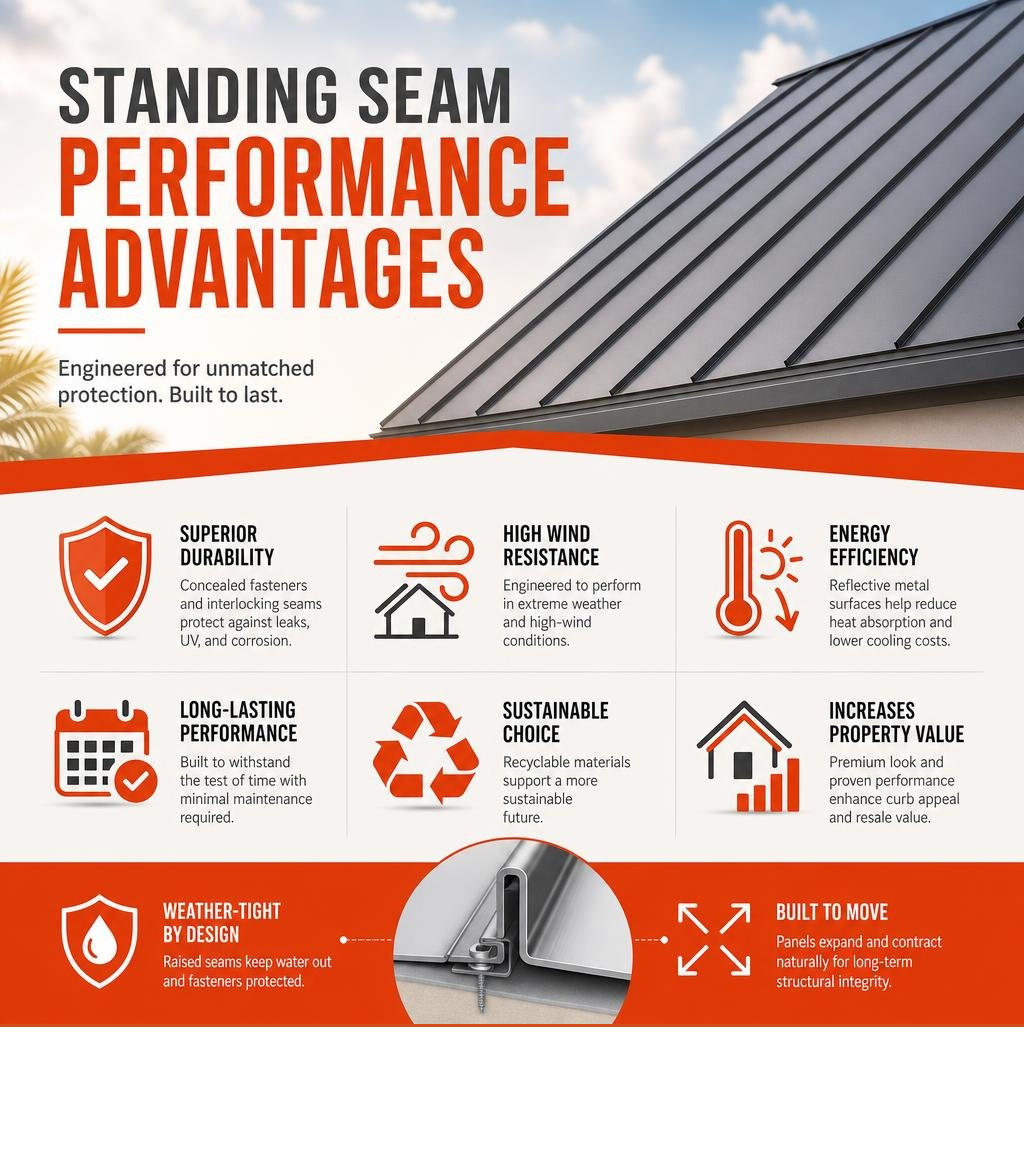
Understanding the top benefits of choosing metal roofing for your home in Melbourne FL often begins with energy efficiency. Reflective cool-roof finishes reflect solar radiation away from the building envelope, contributing to reduced cooling demand. Furthermore, environmental sustainability is built into the material: metal panels typically feature high recycled content and remain fully recyclable at the end of their service life.
Panel Profiles: Snap-Lock vs. Mechanically Seamed
Standing seam roofs are primarily divided into two profile categories: snap-lock systems and mechanically seamed systems. Choosing the right profile depends on the slope of the roof, architectural design, and local wind uplift requirements.
- Snap-Lock Panels: These panels feature roll-formed edges that snap securely together without specialized seaming equipment. They are popular for residential steep-slope applications, typically requiring a minimum roof pitch of 3:12. Snap-lock systems offer efficient installation while keeping fasteners completely concealed.
- Mechanically Seamed Panels: These panels require an electric mechanical seamer to fold the interlocking ribs at either 90 degrees (single-lock) or 180 degrees (double-lock). Mechanical seams provide superior structural strength and wind uplift resistance. They can often be installed on low-slope roofs down to 1/4:12 when paired with specialized butyl seam sealants.
- Symmetrical Systems: Symmetrical mechanical panels allow individual panels to be removed and replaced without dismantling entire roof sections, providing unmatched serviceability for complex architectural designs.
| Feature | Snap-Lock Panels | Mechanically Seamed Panels |
|---|---|---|
| Seam Method | Push-fit snap engagement | Machine-crimped (90° or 180°) |
| Minimum Pitch | Typically 3:12 or greater | Low slope (down to 1/4:12 with sealant) |
| Wind Uplift Capacity | High (ideal for standard residential) | Extreme (ideal for coastal & commercial) |
| Installation Speed | Faster, lower labor profile | Requires specialized seaming machines |
| Common Metal Gauge | 24 to 26-gauge steel or aluminum | 22 to 24-gauge steel or structural aluminum |
How to Choose the Right Standing Seam Roofing Contractor
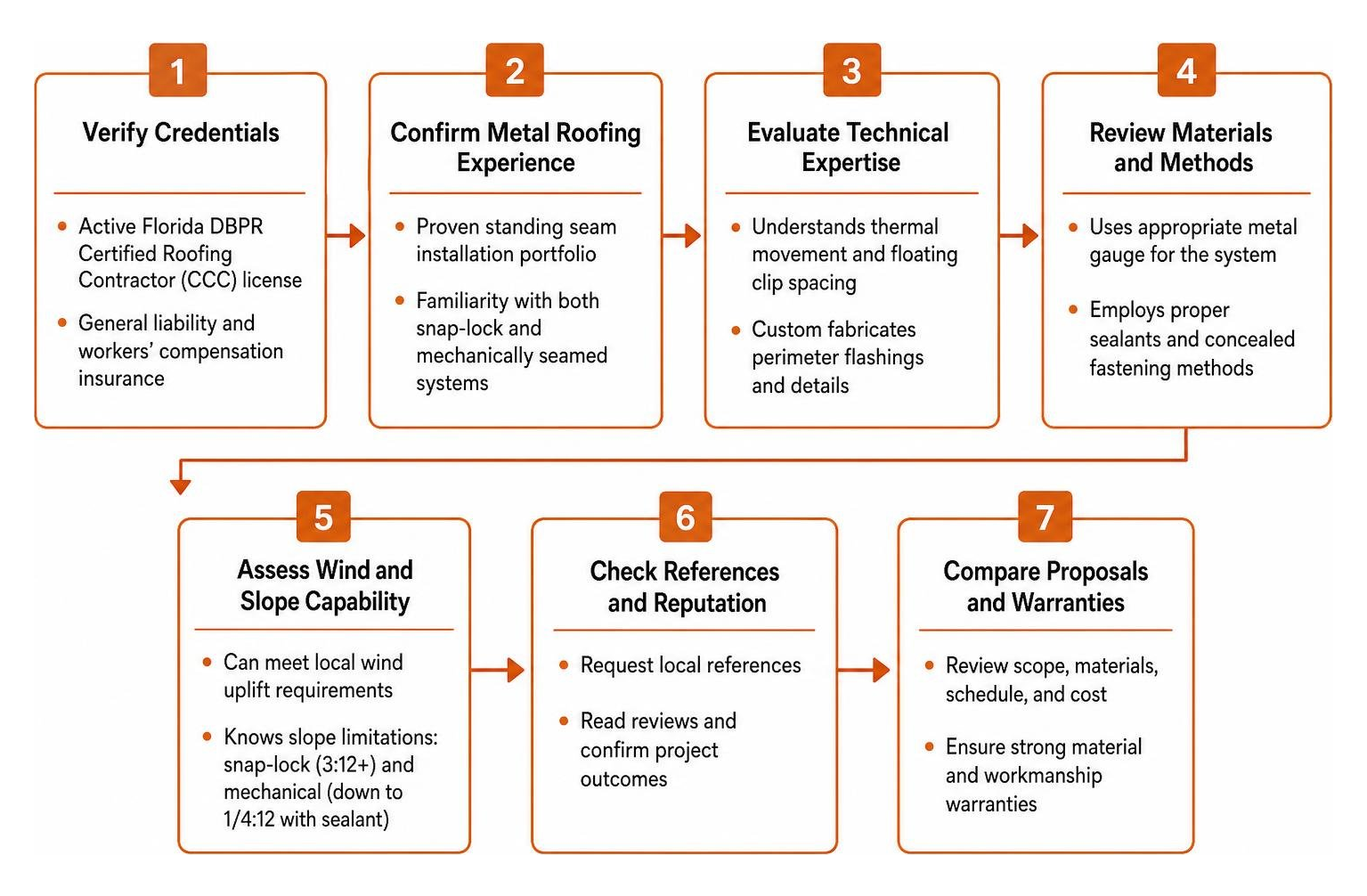
Because standing seam systems are engineered metal assemblies rather than modular shingles, installation requires specialized architectural sheet metal expertise. A contractor must calculate thermal movement, properly space floating clips, and custom-fabricate perimeter flashings. Homeowners looking for the best metal roof repair near me hire honest and highly rated contractors who possess verifiable metal installation backgrounds rather than general roofing experience.
Verifying Qualifications of a Standing Seam Roofing Contractor
When evaluating a standing seam roofing contractor, verifying credentials protects you against improper installation practices. In Florida, roofing contractors must maintain active licensing through the Department of Business and Professional Regulation (DBPR), such as a Certified Roofing Contractor (CCC) license.
Always verify:
- State Licensing and Insurance: Ensure active workers’ compensation and general liability coverage specifically written for roofing operations.
- Trade Specialization: Verify that the contractor has dedicated sheet metal crews rather than general laborers attempting complex metal work.
- Manufacturer Certifications: Certified installers ensure that finish, substrate, and system warranties remain fully valid.
- Documented Portfolio: Look for completed standing seam projects in coastal environments like Rockledge, Palm Bay, and Merritt Island.
Key Questions to Ask a Standing Seam Roofing Contractor
Before signing an agreement, ask detailed technical questions to gauge the contractor’s competence:
- Are your metal panels formed in-house, roll-formed on-site, or ordered from an outside panel house?
- What gauge and substrate are you recommending (e.g., 24-gauge coated steel or .032″ aluminum for coastal salt exposure)?
- What specific underlayment system will be installed beneath the metal panels to handle high heat transfer?
- Do your crews use fixed clips or floating expansion clips to manage thermal movement?
- What does your written workmanship warranty cover compared to the manufacturer material warranty?
The Standing Seam Installation Process and Project Timelines
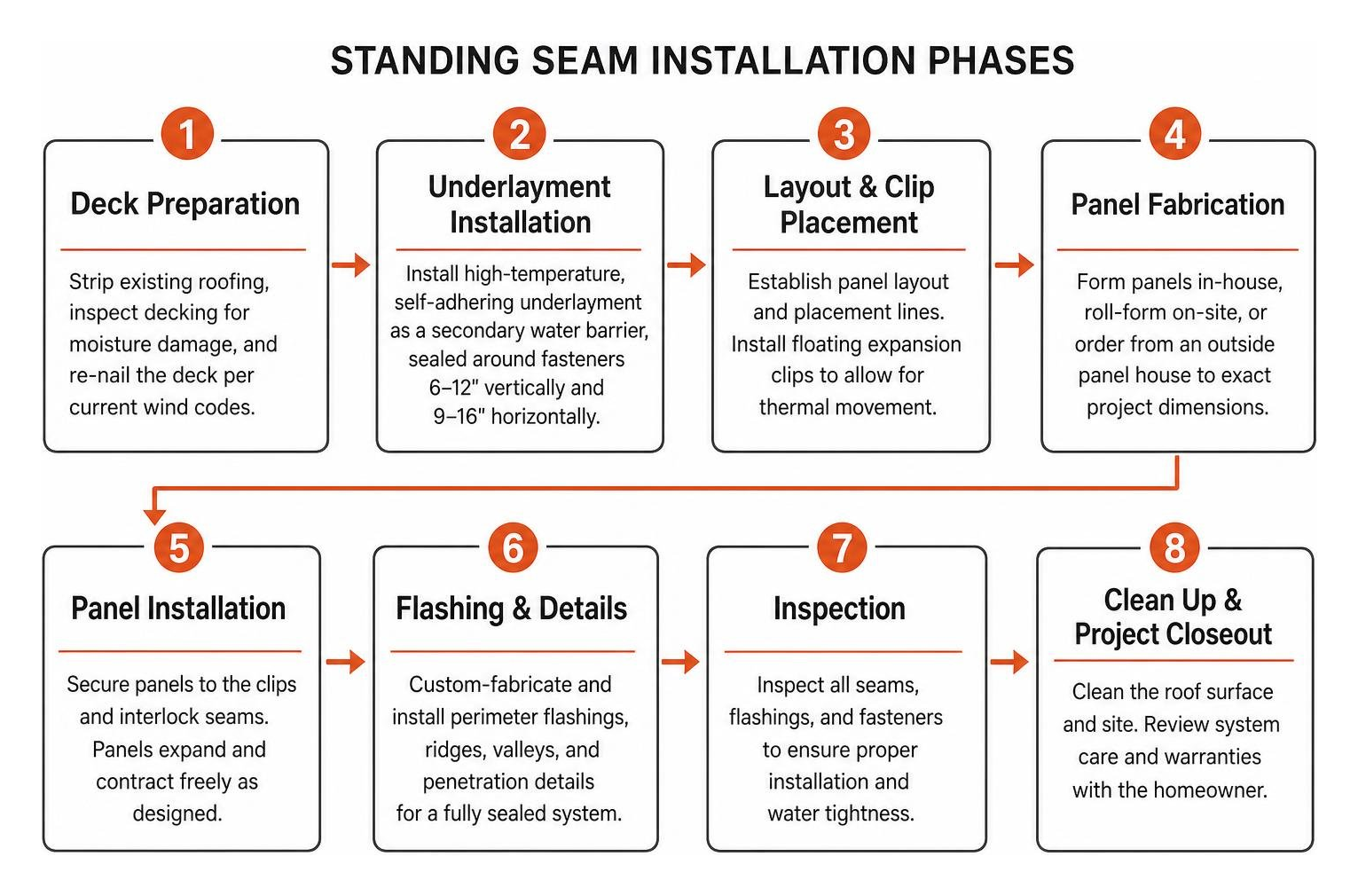
Installing a standing seam roof involves precise craftsmanship across multiple sequential phases. Unlike shingle installations that may take only a single day, standing seam installations on standard homes typically require several days depending on roof complexity, custom metal fabrication, and weather conditions.
Deck Preparation, Underlayment, and Retrofit Considerations
A durable metal roof starts with the roof deck. The installation crew strips existing roofing materials down to the structural sheathing, inspects the decking for moisture damage, and re-nails the deck according to current wind codes.
The underlayment choice is critical. Standing seam metal panels absorb and transfer heat, requiring high-temperature, self-adhering peel-and-stick underlayments. These membranes seal around fastener penetrations across the roof deck. For homeowners evaluating options, articles detailing are metal roofs good in Florida highlight how high-temperature membranes serve as a secondary water barrier during severe weather events.

Roll-Forming, Seaming, and Flashing Details
Once the deck is prepped, panels are either pre-fabricated or formed on-site using portable roll-forming machinery. On-site roll-forming allows for continuous single-length panels, substantially reducing leak-prone horizontal endlaps.
Crews install continuous eave and rake trims, secure panels with concealed clips at engineered intervals, and interlock the vertical ribs. Critical transitions—such as valleys, sidewalls, chimneys, and ridge caps—are finished with custom-bent matching flashing, hemmed into place to avoid exposed face screws.
Investment Breakdown: Costs, Warranties, and Long-Term Value
Standing seam metal roofing requires a higher upfront investment than standard asphalt shingles or exposed-fastener metal roofs. However, evaluating the total lifecycle value shows significant long-term economic returns.

Total project pricing is highly variable and depends on roof pitch, structural geometry, accessibility, selected metal substrate, and code requirements. An in-person professional evaluation is always required to establish an accurate scope. Over an extended homeownership timeline, a single standing seam roof can eliminate multiple shingle replacement cycles. Additionally, impact-resistant metal panels may qualify homeowners for insurance premium discounts with certain carriers. However, insurance coverage and policyholder discounts depend strictly on specific policy language, exclusions, deductibles, roof age, and carrier decisions. For roofs requiring mandated code compliance adjustments, Ordinance or Law coverage may assist with code upgrades without serving as guaranteed coverage.
When planning your roofing investment, understanding the difference between available financing programs is helpful:
| Program Type | Description | Repayment Required? |
|---|---|---|
| Home Improvement Financing | Contractor-partnered installment loans or lines of credit | Yes (monthly principal & interest payments) |
| Government / Weatherization Grants | Public assistance programs for qualifying low-income or resilience upgrades | No (grants generally do not require repayment) |
| Home Equity Line of Credit (HELOC) | Bank loan secured by accumulated residential home equity | Yes (variable or fixed monthly repayment) |
Grants typically do not require repayment while standard loans and private financing options do, making it important to review budget fit before starting your project.
Material Warranties and Workmanship Coverage
A dependable standing seam installation includes multiple layers of warranty protection:
- Finish Warranties: Premium PVDF coatings typically carry multi-decade warranties against chalking, fading, and peeling.
- Substrate Warranties: Architectural steel systems typically provide multi-decade manufacturer perforation warranties.
- Contractor Workmanship Coverage: Reputable installers provide multi-year workmanship guarantees covering flashing, transitions, and installation watertightness.
Long-Term Maintenance and System Care
While standing seam systems are exceptionally durable, routine preventative care ensures optimal performance over decades. Homeowners should keep drainage valleys, scuppers, and gutters free of leaf debris. Periodic inspections should focus on sealants around pipe boots, transition flashings, and rooftop HVAC units to address small issues before they become active leaks.
Frequently Asked Questions About Standing Seam Metal Roofing
Can standing seam metal panels be installed over an existing roof?
In certain recover scenarios, lightweight standing seam panels can be installed over existing roofs using specialized sub-framing or clip systems. However, local building codes, structural load capacities, moisture trapping risks, and deck integrity must be evaluated by a licensed professional. In many coastal environments, a full tear-off down to the decking is recommended to inspect the underlying wood deck and install high-temperature peel-and-stick underlayment.
How does standing seam compare to exposed fastener roofing systems?
Exploring hidden fastener vs exposed fastener choosing the right metal roof for you reveals that exposed fastener roofs use external screws with rubber washers that penetrate the panel surface. Over time, UV exposure and natural thermal expansion can degrade these washers and back out screws, creating leak risks. Standing seam systems conceal all fasteners beneath interlocking seams, eliminating exterior screw penetrations across the roof plane.
Can solar panels be mounted to standing seam roofs without drilling?
Yes. One of the greatest engineering advantages of standing seam metal roofs is direct solar integration. Specialized non-penetrating seam clamps grip the raised vertical ribs without piercing the roof deck or penetrating the waterproof metal surface. This preserves the roof’s watertight integrity and protects manufacturer warranties while supporting residential solar arrays.
Conclusion
A standing seam metal roof is a premier residential roofing investment, offering decades of weather protection, high wind resistance, and architectural elegance. Achieving these long-term benefits requires partnering with an experienced, licensed, and insured contractor who understands precision sheet metal layout, thermal movement, and quality flashing fabrication.
MLG Roofing provides homeowners throughout Brevard County, FL—including Melbourne, Palm Bay, West Melbourne, Rockledge, Viera, Merritt Island, Cocoa, and Sebastian—with expert roof evaluations, transparent estimates, and quality craftsmanship. Whether you are assessing storm damage, considering a full roof replacement, or comparing roofing materials, our team is ready to guide you. Contact MLG Roofing today to explore standing seam metal roofing services and schedule a comprehensive professional roof assessment.