
Why Storm Damage Commercial Roof Repair Requires Immediate Attention

If your commercial property in Brevard County, FL has been hit by a storm, here is what you need to know right away:
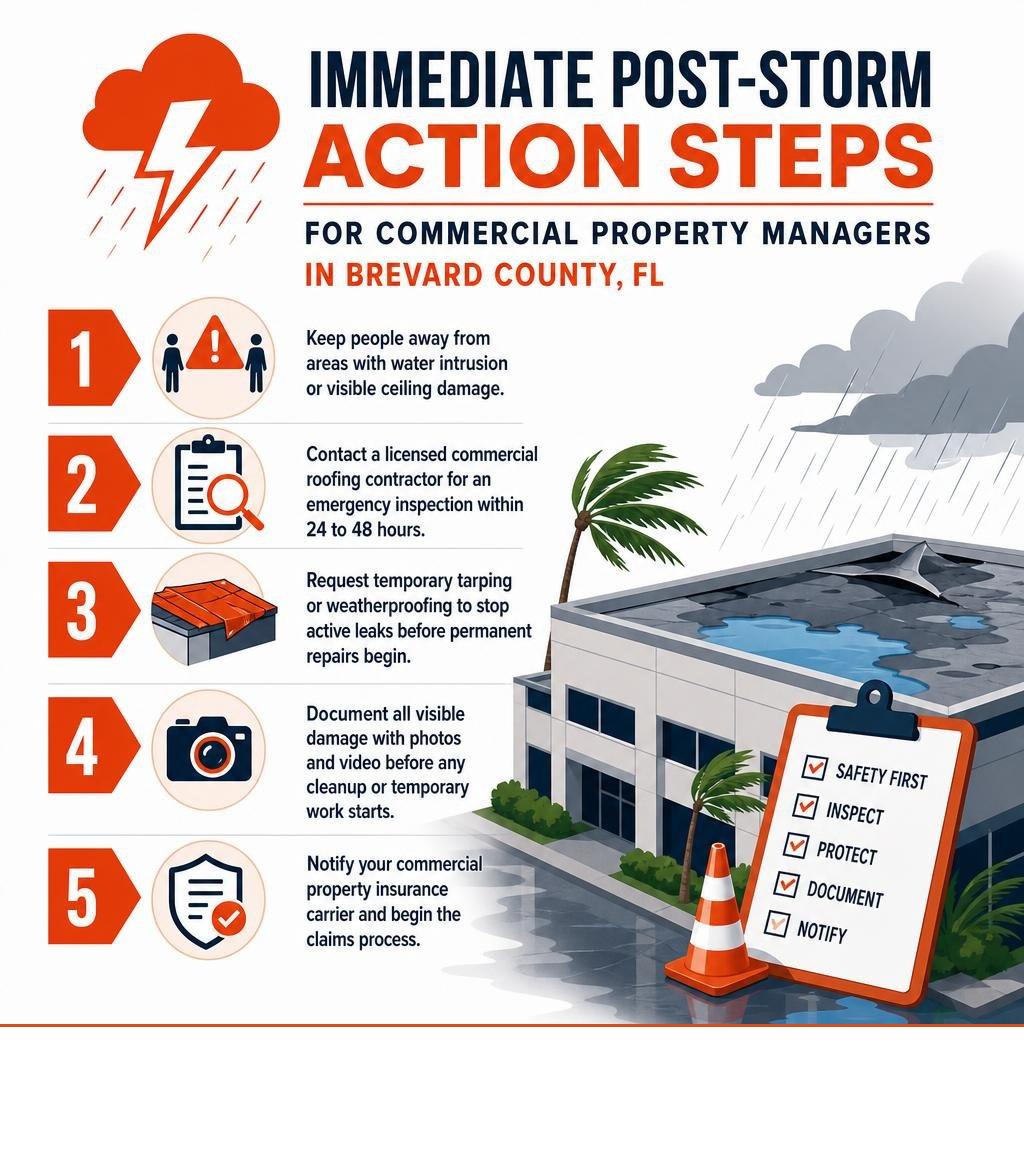
Immediate steps after commercial roof storm damage:
- Keep employees and tenants away from areas showing water intrusion or visible ceiling damage
- Contact a licensed commercial roofing contractor for an emergency inspection within 24 to 48 hours
- Request temporary tarping or weatherproofing to stop active leaks before permanent repairs begin
- Document all visible damage with photos and video before any cleanup or temporary work starts
- Notify your commercial property insurance carrier and begin the claims process
Storm damage commercial roof repair is one of the most time-sensitive situations a business owner or facility manager can face on the Space Coast. Brevard County sits in one of the most storm-exposed corridors in Florida. Between Atlantic hurricane activity, which is monitored closely by the National Hurricane Center, fast-moving severe thunderstorms, and strong coastal winds, commercial roofs here take a beating that most inland properties simply do not experience.
The challenge is that storm damage to a commercial roof is not always obvious right away. A hailstorm that passed through Melbourne or Cocoa last week may have left behind damage that only shows up as a leak weeks later. Wind events can lift membrane edges or loosen flashing without leaving visible signs from the ground. By the time water shows up on your ceiling or floor, the damage inside the roof assembly may already be significant.
Acting quickly after a storm is not just about fixing a roof. It is about protecting your inventory, your tenants, your equipment, and your business operations. Delays in addressing storm damage consistently lead to higher repair costs, more complex insurance claims, and longer disruptions to normal business activity.
This guide walks commercial property owners and facility managers through everything involved in managing storm damage on a commercial roof, from the moment the storm clears to the final inspection after repairs are complete.
The Reality of Storm Damage Commercial Roof Repair on the Space Coast

Commercial buildings on the Space Coast are subject to intense, localized weather events. From tropical depressions to sudden summer microbursts, the atmospheric pressure changes and wind speeds can put immense stress on commercial flat and low-slope roofing systems. Understanding how these storms physically affect your building is the first step in managing a successful recovery.
To protect your asset, it is helpful to familiarize yourself with the Brevard County Storm Damage Repair and Identification Guide, which details how coastal weather systems interact with commercial structures. Whether your building uses single-ply membranes, modified bitumen, or metal roofing, the physical forces of a storm present distinct structural challenges.
Wind Uplift and Perimeter Damage
Wind damage on commercial flat roofs rarely starts in the center of the roof. Instead, it begins at the edges. When strong winds rush over the edge of a commercial building, they create a vacuum effect known as wind uplift. If the perimeter flashing or coping metal is even slightly loose, the wind can get underneath the roofing material.
Once the wind gets under the membrane, it can peel the roofing material away from the roof deck. This lifting action can tear the seams of single-ply membranes like TPO or EPDM, pull fasteners out of the decking, and leave the building’s structural roof deck completely exposed to subsequent rainfall.
Hail Impact and Membrane Punctures
While hail may seem like a rare concern on the coast, severe seasonal storms regularly bring hailstones that can severely compromise commercial membranes. When hail strikes a low-slope roof, it can cause immediate physical punctures or create hidden microfractures.
On single-ply systems, hail impacts can fracture the reinforcing scrim inside the membrane. On modified bitumen or built-up roofs, hail can displace the protective mineral granules, exposing the underlying asphalt to rapid UV degradation. These impacts often look like minor bruises from the ground, but they compromise the waterproof integrity of the system and eventually lead to slow, hard-to-find leaks.
Debris Impact and Drainage Failures
High winds turn everyday objects, tree branches, and loose rooftop equipment into dangerous projectiles. Flying debris can easily puncture single-ply membranes, dent metal roofing panels, or damage critical flashing around HVAC units and plumbing vents.
Additionally, storms often wash leaves, branches, and trash into commercial roof drains and scuppers. When drainage systems become clogged during a heavy downpour, water quickly pools on the flat surface. Flat roofs are designed to handle a certain amount of temporary water, but sustained ponding water adds immense weight to the building’s structure, increasing the risk of structural deflection or severe structural strain.
How Storm Damage Impacts Commercial Building Operations and Safety

For a business, a leaking roof is not just a building maintenance issue—it is an operational threat. When storm damage compromises a commercial roof, the consequences quickly spread beyond the rooftop, affecting daily business activities, safety compliance, and the bottom line.
Water intrusion is the most immediate threat. When rainwater bypasses a damaged roof membrane, it migrates through the ceiling assembly and can pool in tenant spaces, offices, or warehouse floors. This leads to immediate tenant complaints, especially in multi-family commercial properties or leased office spaces where business operators expect a dry, safe working environment.
For industrial and retail properties, water intrusion can ruin expensive inventory, damage manufacturing equipment, and short-circuit electrical systems. If water reaches sensitive machinery or server rooms, the resulting equipment exposure can halt production entirely, leading to significant lost revenue and missed deadlines.
Furthermore, water trapped within the insulation and ceiling materials creates a conducive environment for mold and mildew growth. Mold risk can develop within 24 to 48 hours of water exposure, creating indoor air quality issues that threaten employee safety and may violate local health regulations.
To prevent these compounding issues, implementing proactive mitigation strategies—such as scheduling immediate professional inspections and organizing emergency temporary repairs—is the most effective way to protect your business assets and maintain operational continuity.
The Commercial Storm Damage Roof Repair Process and Timelines
When managing storm damage commercial roof repair, having clear expectations about the timeline is critical for planning business operations. The recovery process moves through distinct phases, starting with immediate emergency response and ending with the final closeout of permanent repairs.
To ensure your building remains protected throughout this process, utilizing professional Emergency Roof Repair services is essential to bridge the gap between initial damage and permanent reconstruction.
Phase 1: Immediate Mitigation and Tarping
The first 24 to 48 hours after a storm are focused entirely on stopping active leaks and protecting the building interior. During this phase, a professional team will deploy temporary weatherproofing measures.
This often involves installing heavy-duty polyethylene tarps secured with wood lath and screws, or applying temporary membrane patches over punctured areas. The goal of this phase is to secure the building envelope so that your business can continue to function while the permanent repair plan is developed.
Phase 2: Professional Assessment and Insurance Review
Once the building is temporarily stabilized, a comprehensive roof inspection is conducted to document the full extent of the damage. This assessment includes photographing all affected areas, identifying structural damage, and mapping moisture intrusion.
The resulting documentation package is then submitted to your commercial property insurance carrier. The insurance review phase can vary in length, as it involves coordination with adjusters, reviewing policy coverages, and processing the claim. Having a detailed, professional documentation package is the most effective way to streamline this phase and minimize delays.
Phase 3: Permanent Repairs and Closeout
Once the insurance claim is processed and the scope of work is finalized, permanent repairs begin. The timeline for this phase is influenced by material lead times, weather conditions, and the complexity of the project.
For many commercial properties, repairs can be completed in phases to minimize disruptions to building occupants. Once the physical work is complete, a final inspection is performed to ensure all repairs meet local building codes and manufacturer warranty standards, allowing the project to be officially closed out.
Navigating Commercial Insurance Claims and Documentation
Managing a commercial insurance claim after a storm can be a complex process for property managers. Unlike residential claims, commercial claims often involve large property values, business interruption calculations, and strict code compliance requirements.
Detailed documentation is the foundation of any successful commercial insurance claim. Following a storm, your roofing partner will use advanced tools to capture the exact state of your roof. This often includes drone imagery to show wide-angle wind patterns and membrane displacement, as well as moisture mapping to identify water trapped beneath the surface that is not visible to the naked eye.
When coordinating with insurance adjusters, having organized, professional evidence is invaluable. It ensures that all eligible damages—including compromised insulation, damaged flashing, and affected rooftop equipment—are clearly represented in the initial claim. This reduces the need for lengthy disputes and helps speed up the overall claim timeline.
Additionally, commercial property owners must consider code upgrade requirements. If your building has an older roof system, current local building codes may require upgrades to wind-rated fasteners, insulation values, or drainage systems during the repair process. A professional roofing contractor will help document these requirements so they can be factored into your insurance coverage.
For a deeper understanding of how to manage this process, you can consult the guide on Navigating Insurance Claims: A Step-by-Step Guide for Roofing Damages to prepare for your discussions with adjusters and carriers.
Repair vs. Replacement: Making the Best Business Decision
One of the most important decisions a facility manager must make after a storm is whether to perform targeted repairs or invest in a full roof replacement. Making the right choice requires evaluating the overall structural integrity of the building, the age of the existing roof, and the long-term asset management goals of your business.
The table below outlines the primary factors to consider when comparing these two options:
| Decision Factor | Targeted Commercial Roof Repair | Full Commercial Roof Replacement |
|---|---|---|
| Damage Extent | Localized to specific areas (e.g., a few punctures or minor perimeter damage). | Widespread membrane tearing, extensive wet insulation, or structural damage. |
| Roof System Age | The existing roof is relatively young and has been well-maintained. | The roof is near the end of its expected service life. |
| Code Compliance | Typically does not trigger extensive code-mandated upgrades. | Requires the entire system to be brought up to current local building codes. |
| Cost-Effectiveness | Lower immediate cost; ideal for short-term budget management. | Higher upfront investment; provides long-term value and lowers maintenance costs. |
| Warranty Status | May maintain existing manufacturer warranties if performed by a certified contractor. | Comes with a brand-new, comprehensive manufacturer and workmanship warranty. |
The best path forward depends on a professional evaluation of your specific roof system. A certified commercial roofing contractor can perform insulation moisture assessments and physical roof inspections to determine if the underlying insulation is dry enough to support a repair, or if moisture has spread so widely that a replacement is the most effective way to protect the building.
Frequently Asked Questions About Commercial Storm Damage
Does insurance cover storm damage commercial roof repair?
In many cases, commercial property insurance policies may cover roof repairs or replacement if the damage was caused by a sudden, accidental event such as wind, hail, or falling debris. However, coverage depends on the specific terms of your policy, your deductible, and whether you have maintained the roof properly prior to the storm. Policies often include “ordinance or law” coverage, which helps pay for required building code upgrades during the repair process.
How long does storm damage commercial roof repair take?
The overall timeline is highly variable and depends on several factors, including the extent of the damage, the size of your roof, material availability, and weather conditions. Immediate emergency mitigation and tarping can typically be completed within a few days of the storm. The permanent repair phase can take anywhere from a few days to several weeks, depending on how quickly the insurance claim is processed and the complexity of the project.
Can my business remain open during commercial roof repairs?
In most cases, yes. Professional commercial roofing contractors understand the importance of operational continuity and will work to minimize disruptions. This is often achieved through phased construction, where work is completed on one section of the building at a time. Safety protocols, including secure pedestrian pathways and noise management strategies, are put in place to ensure your employees, tenants, and customers remain safe throughout the repair process.
Conclusion
Managing storm damage commercial roof repair on the Space Coast requires a balanced focus on immediate risk mitigation, business continuity, and long-term asset protection. When a severe storm impacts your property in Brevard County, FL, delaying repairs can quickly lead to compounding interior damage, operational disruptions, and costly insurance disputes.
At MLG Roofing, we understand the unique challenges that commercial property owners and facility managers face after a major weather event. By focusing on rapid emergency response, detailed documentation, and professional coordination with insurance adjusters, we help streamline the recovery process so you can focus on running your business.
If you suspect your commercial building has sustained storm damage, do not wait for a leak to appear inside. Contact MLG Roofing today to schedule a comprehensive, professional inspection and protect your commercial investment for years to come.