How to Evaluate Hail Dents on Metal Roofing in Brevard County, FL
Most hail dents on metal roofs affect appearance, not how the roof sheds water. They do not automatically void a warranty. But dents that split a panel, disturb a seam, or expose bare metal need a closer look. Warranty and insurance coverage depend on the damage and the terms of each document. Learning to read storm damage correctly is the first step toward protecting both your warranty and your home.
After a storm, photograph what you can see from the ground to document any potential wind damage to roof components. Then have qualified metal roofing repair contractors perform a comprehensive assessment as part of your ongoing roof repair and maintenance plan. On the Space Coast, that inspection should pay close attention to seams and coatings exposed to wind-driven rain and salt air.
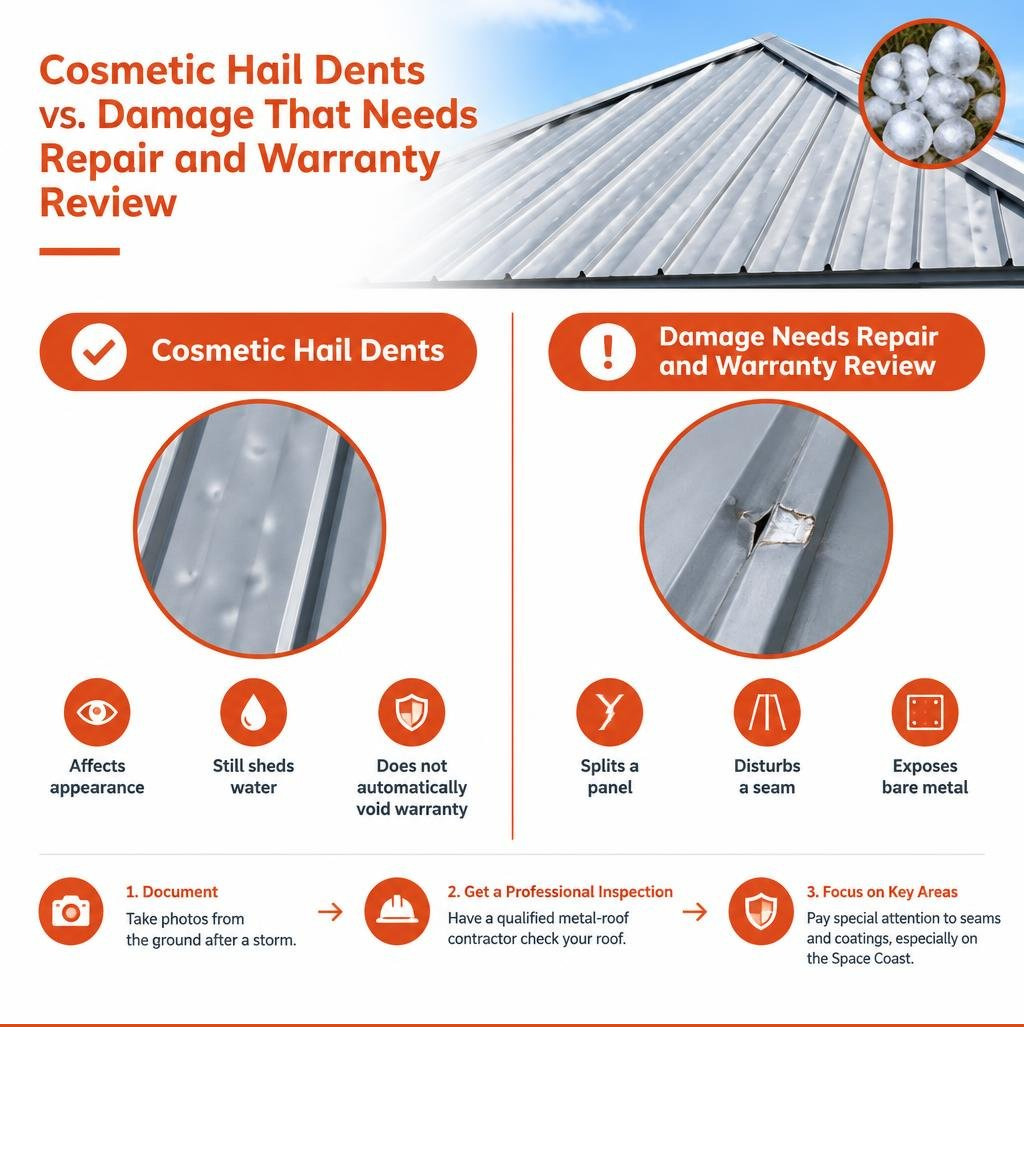
Properly evaluating metal roof impact conditions helps property owners distinguish between harmless surface dimples and functional defects requiring prompt service.
Understanding Hail Damage on Metal Roofs: Cosmetic vs. Functional
When a severe thunderstorm sweeps across Central Florida, strong winds and hail dent metal roofing systems depending on steel gauge thickness, material yield strength, impact velocity, and panel profile geometry. A steeper roof slope (such as 6:12 or greater) deflects falling stones and reduces impact energy, whereas low-slope profiles absorb direct 90-degree hits.
According to metal engineering standards outlined in technical bulletins on coated sheet steel roofing, the dent resistance of steel is proportional to the square of its yield strength multiplied by the fourth power of its sheet thickness. While metallic coatings protect against the elements, the structural substrate absorbs the physical force. Homeowners evaluating metal roofing in Brevard County must understand whether impact marks represent cosmetic surface dimples or functional compromises that demand corrective action.
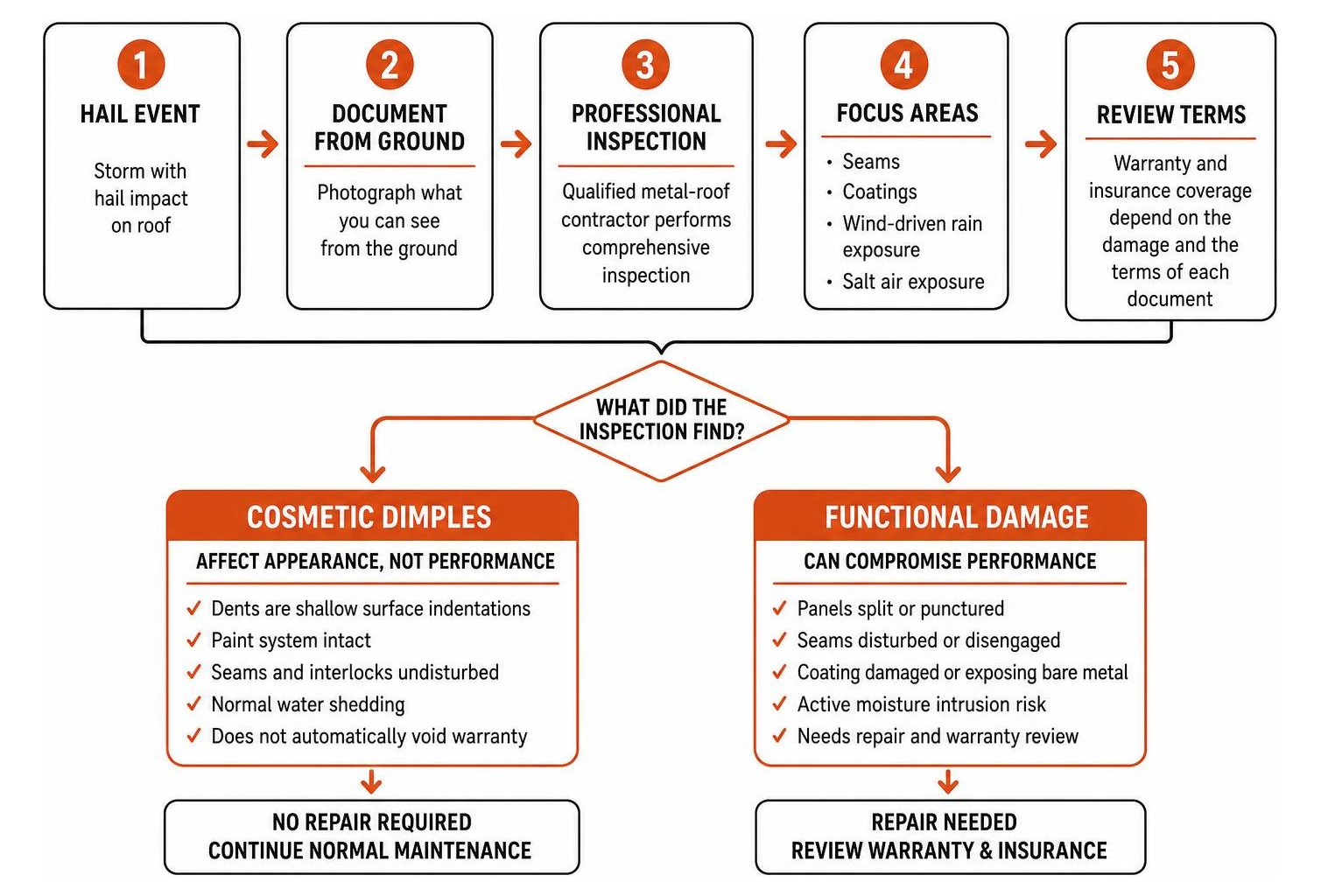
Cosmetic Dimpling and Water Shedding Performance
Cosmetic dimpling refers to shallow surface indentations that do not alter the roof’s primary job: keeping water out of the building envelope. Testing on 26-gauge coated steel panels shows that simulated impacts from 1.25- to 2.0-inch spheres produce dent depths ranging from 0.010 to 0.159 inches.
Independent research, including field investigations conducted by the Roofing Industry Committee on Weather Issues (RICOWI), confirms that these shallow dimples do not inhibit water-shedding performance. Research published by the Metal Building Manufacturers Association (MBMA) evaluated standing seam panels and found that water sitting in hail divots up to 0.160 inches deep actually evaporates faster than moisture trapped behind normal mechanical stiffening flutes or along sheared panel eaves. Because these minor indentations leave concealed fasteners, structural clips, and interlocks undisturbed, the panel continues to perform as intended.
Functional Compromise and Hidden Seam Failures
Functional damage occurs when an impact breaches the roof’s water barrier, diminishes its structural strength, or shortens its expected service life. Very large hailstones—typically exceeding 2 to 2.5 inches in diameter—can impart enough concentrated force to distort panel side laps, disengage mechanical seams, or crack protective factory finishes.
| Damage Indicator | Cosmetic Dimple | Functional Compromise |
|---|---|---|
| Coating Condition | Finish intact; no micro-cracking or base metal exposure | Visible paint fracturing, crazing, or exposed steel substrate |
| Seam & Side Lap Integrity | Standing seams and interlocking laps remain tight and true | Seams pulled apart, clips deformed, or laps visibly distorted |
| Fastener Status | Fasteners firmly seated with intact EPDM sealing washers | Fasteners loosened, pulled sideways, or washers crushed/torn |
| Moisture Risk | No pathway for water intrusion; normal surface evaporation | Potential capillary water draw or wind-driven rain penetration |
| Underlayment Status | Underlying deck and self-adhered membranes undamaged | Punctures or localized crushing of synthetic underlayment |
When a seam separates or an exposed fastener backs out, wind-driven rain can penetrate beneath the panels. In coastal environments like Melbourne and Satellite Beach, hidden seam distortion creates entry points for moisture that can degrade the substrate and synthetic underlayment long before water shows up on an interior ceiling.
Impact Resistance Ratings and Material Performance
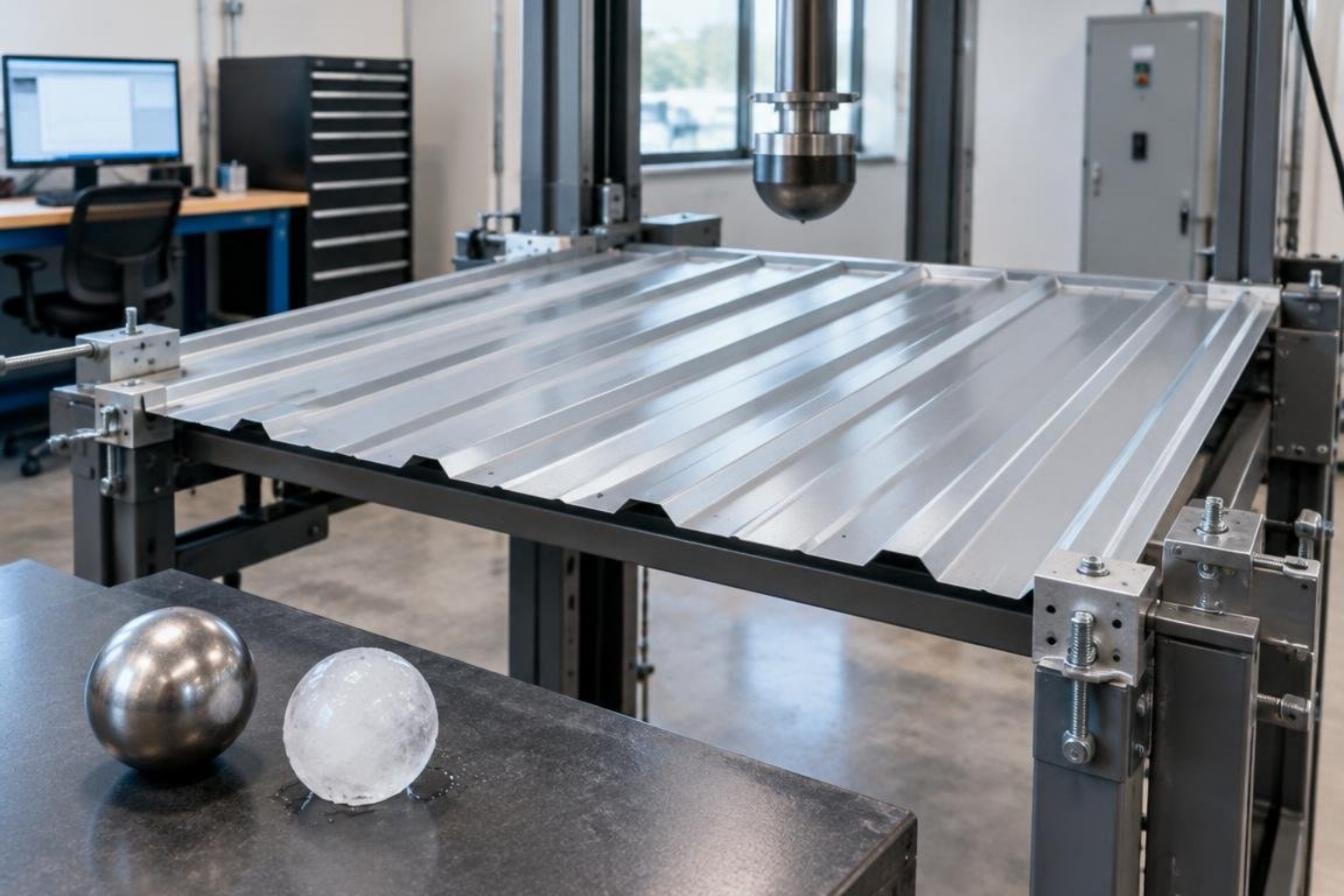
To help property owners gauge panel durability, testing organizations rely on standardized impact protocols. The primary standard for residential and commercial roofing is UL 2218, which assigns ratings from Class 1 through Class 4 based on steel ball drop testing. Class 4 is the most rigorous, requiring a panel to withstand the impact of a 2.0-inch steel ball dropped from a height of 20 feet (delivering approximately 23.7 ft-lbs of kinetic energy) twice in the same spot without cracking or rupturing.
Building codes and insurance underwriters also reference FM 4471 and FM 4473 standards for severe hail classifications. Understanding these benchmarks helps homeowners selecting low maintenance metal roofing options understand how various profiles handle storm conditions.
Laboratory Standards vs. Real-World Hail Impact
While UL 2218 provides a dependable baseline, laboratory conditions differ from actual storm mechanics:
- Steel Spheres vs. Natural Ice: Steel balls are rigid and do not crush or shatter upon impact. Hailstones vary in density, shape, and hardness, often fracturing on contact and dispersing part of their kinetic energy.
- Impact Angles: Laboratory testing drops weights at a direct 90-degree angle. Natural hail usually strikes at an angle influenced by storm winds, reducing perpendicular impact force on sloped roofs.
- Coating Resilience: Testing has shown that while dense steel spheres can scuff certain factory topcoats, natural ice impacts of equivalent energy rarely split flexible paint systems.
- Corrosion Performance: In ASTM G85 salt spray testing documented in industry studies on coated panel hail corrosion, 26-gauge panels subjected to 2-inch impacts showed no substrate corrosion after 336 hours of continuous exposure.
- Long-Term Field Evidence: A 43-year field study of a Denver metal roof revealed that micro-crazing from original factory roll-forming was roughly 50 times larger than hail-induced micro-fractures, yet the panels showed no signs of premature failure.
Material Durability: Standing Seam, R-Panel, and Corrugated Profiles
Panel profile and fastening design play a major role in overall hail response:
- Concealed-Fastener Standing Seam: Systems manufactured with 24-gauge Grade 50 or Grade 80 steel provide superior resistance to functional storm damage. Because fasteners and clips are protected beneath the seams, thermal movement and surface impacts rarely compromise the anchoring points. Property owners should ensure their standing seam roofing contractor uses properly rated clips to maintain seam integrity during high-wind storms.
- Exposed-Fastener R-Panels: Common in agricultural and light commercial applications, 26-gauge R-panels feature broad flat areas that show hail impacts more visibly. The primary vulnerability sits at the fastener heads; direct hits near screws can compress or distort neoprene sealing washers, creating localized leak risks.
- Corrugated Profiles: The continuous wave pattern of corrugated panels helps deflect hail impacts. However, thinner 29- or 32-gauge variations remain susceptible to visible dimpling and rib distortion under moderate-to-large hail.
How Hail Dents Impact Manufacturer and Finish Warranties
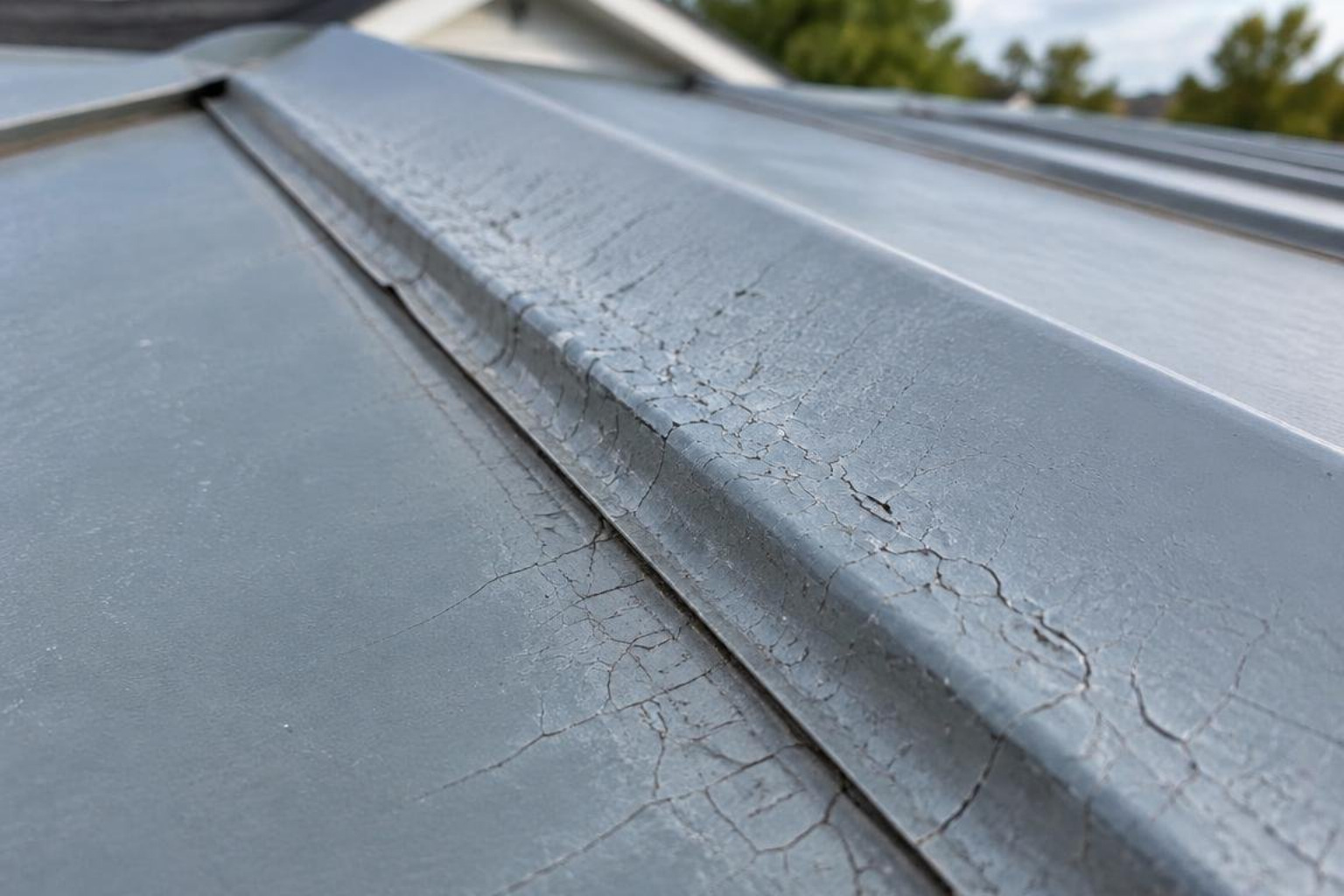
Metal roof warranties are divided into two distinct protections: the finish warranty (covering paint chalking, peeling, and fading) and the substrate warranty (covering metal perforation and structural corrosion). High-performance paint finishes—such as Polyvinylidene Fluoride (PVDF) and Silicone Modified Polyester (SMP)—are engineered for flexibility and UV resistance, but concentrated hail impacts test the outer limits of coating elasticity.
Homeowners planning residential metal roof repairs should review their warranty documents carefully. While cosmetic dents do not instantly void an entire roof warranty, unaddressed finish cracking or unauthorized repair attempts can leave panels unprotected against future claims.
Paint Crazing, Micro-Cracks, and Long-Term Corrosion
When an impact stretches metal beyond its yield point, the paint layer undergoes microscopic stretching known as paint crazing. In benign inland climates, minor crazing rarely leads to rapid deterioration because the underlying protective alloy coating provides galvanic protection to exposed base steel.
Along the Space Coast—in towns such as Cocoa Beach, Indian Harbour Beach, and Palm Bay—marine salt air alters this equation. Airborne chlorides settle into paint fissures. Over time, the combined exposure to concentrated UV radiation, high ambient humidity, and salt spray can accelerate finish degradation, transforming cosmetic crazing into localized edge peeling and surface oxidation.
Why Unaddressed Dents Jeopardize Exterior Coverage
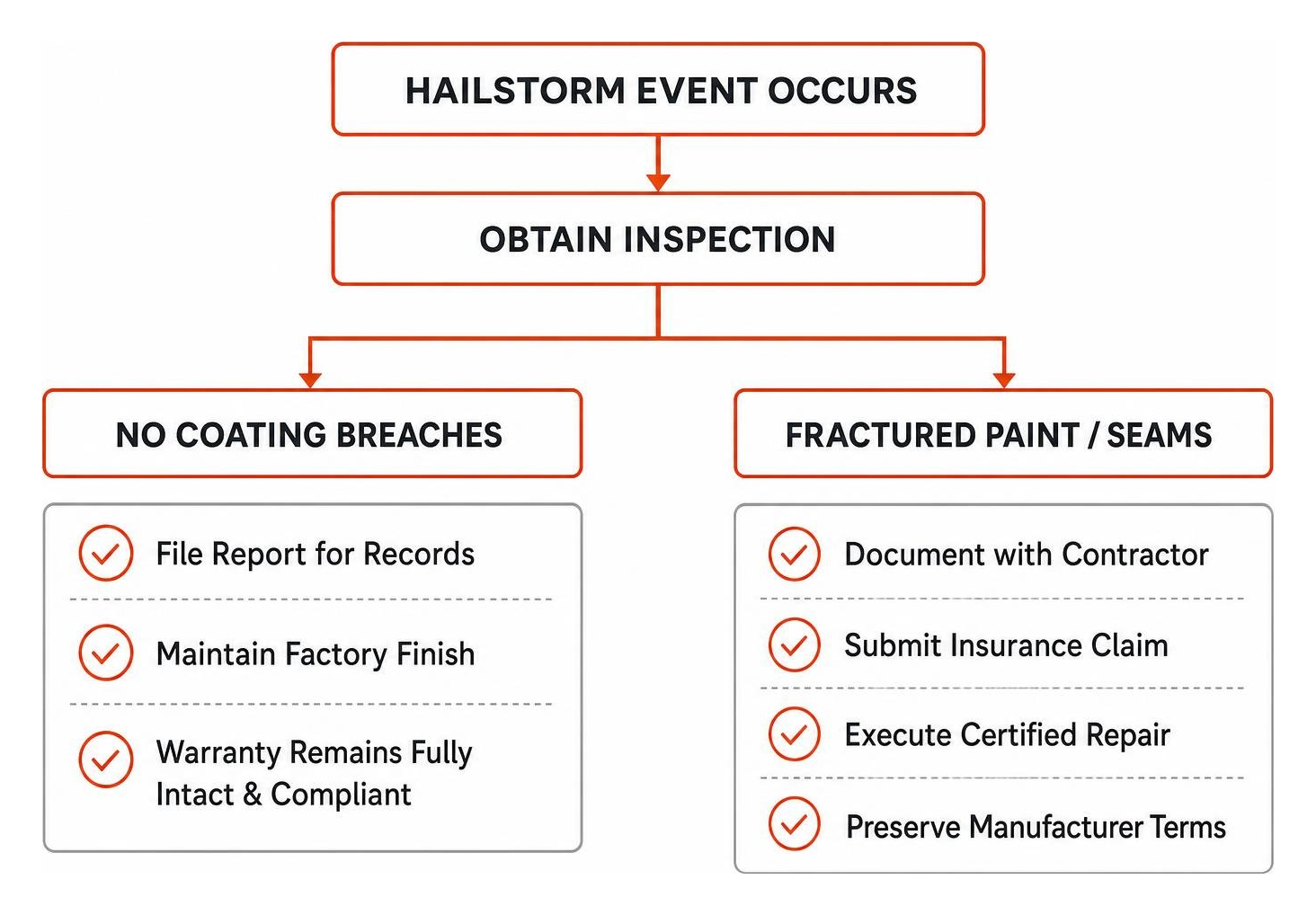
Manufacturer warranties typically exclude damage caused by foreign objects, natural disasters, and third-party modifications. If severe hail creates unaddressed functional defects, exterior warranty coverage may be compromised in several ways:
- Third-Party Alteration Exclusions: Applying unapproved consumer paints, caulk, or automotive fillers over dented panels violates factory guidelines and voids the finish warranty for those sections.
- Concealed Clip and Fastener Shifts: Undocumented structural shifting or seam disengagement left unrepaired can lead to wind-uplift failure during a tropical storm, which manufacturers may classify as storm-related neglect.
- Transferability Forfeiture: If a property in Rockledge or Viera is sold, real estate transfers often require a roof condition certification. Unresolved storm damage on record can prevent the transfer of remaining paint and substrate warranties to the new buyer.
Insurance Coverage, Cosmetic Waivers, and Repair Options
Filing a claim for hail damage on a metal roof requires clear distinction between cosmetic blemishes and covered physical losses. Many standard homeowners insurance policies in Florida include a Cosmetic Damage Exclusion Endorsement (often called a cosmetic hail waiver). Under this endorsement, the insurer does not pay for repairs or replacement if the hail only alters the roof’s visual appearance without causing leaks or compromising its water-shedding capability.
If an impact tears the panel, fractures the seam, exposes bare steel, or damages the underlayment, the loss is typically classified as functional damage. Coverage outcomes depend on policy language, exclusions, deductibles (such as separate hurricane or all-peril deductibles), carrier decisions, and roof age provisions. In addition, Ordinance or Law coverage may help cover the cost of code-required upgrades if included in the policy. To substantiate a functional claim, homeowners should follow standard storm documentation steps and consult a storm damage roof assessment guide before meeting with adjusters.
Evaluating Repair Methods for Hail-Dented Metal Roofing
When repairs are required to restore weatherproofing or address finish breaches, several roofing techniques are available depending on panel style and damage severity:
| Repair Method | Best Suited For | Invasiveness | Warranty Impact |
|---|---|---|---|
| Panel Section Replacement | Deeply creased panels, split metal, or damaged standing seams | Moderate to High; requires unseaming or removing adjacent panels | Restores structural performance; requires certified factory panels to maintain system warranty |
| Localized Seam Realignment | Disengaged mechanical seams or distorted standing seam ribs | Low to Moderate; localized mechanical re-crimping and clip verification | Restores water-tight seal without altering panel composition or substrate warranties |
| Fastener & Washer Servicing | Distorted sealing washers or backed-out exposed fasteners | Low; replacing damaged hardware with new corrosion-resistant fasteners | Secures attachment points and prevents leaks without compromising panel integrity |
| Factory-Approved Finish Touch-Up | Minor surface scuffs or coating crazing where metal substrate is intact | Low; applying manufacturer-specified air-dry formulations | Seals micro-fissures against salt air while maintaining finish warranty standards |
Partial Repair vs. Full Roof Replacement
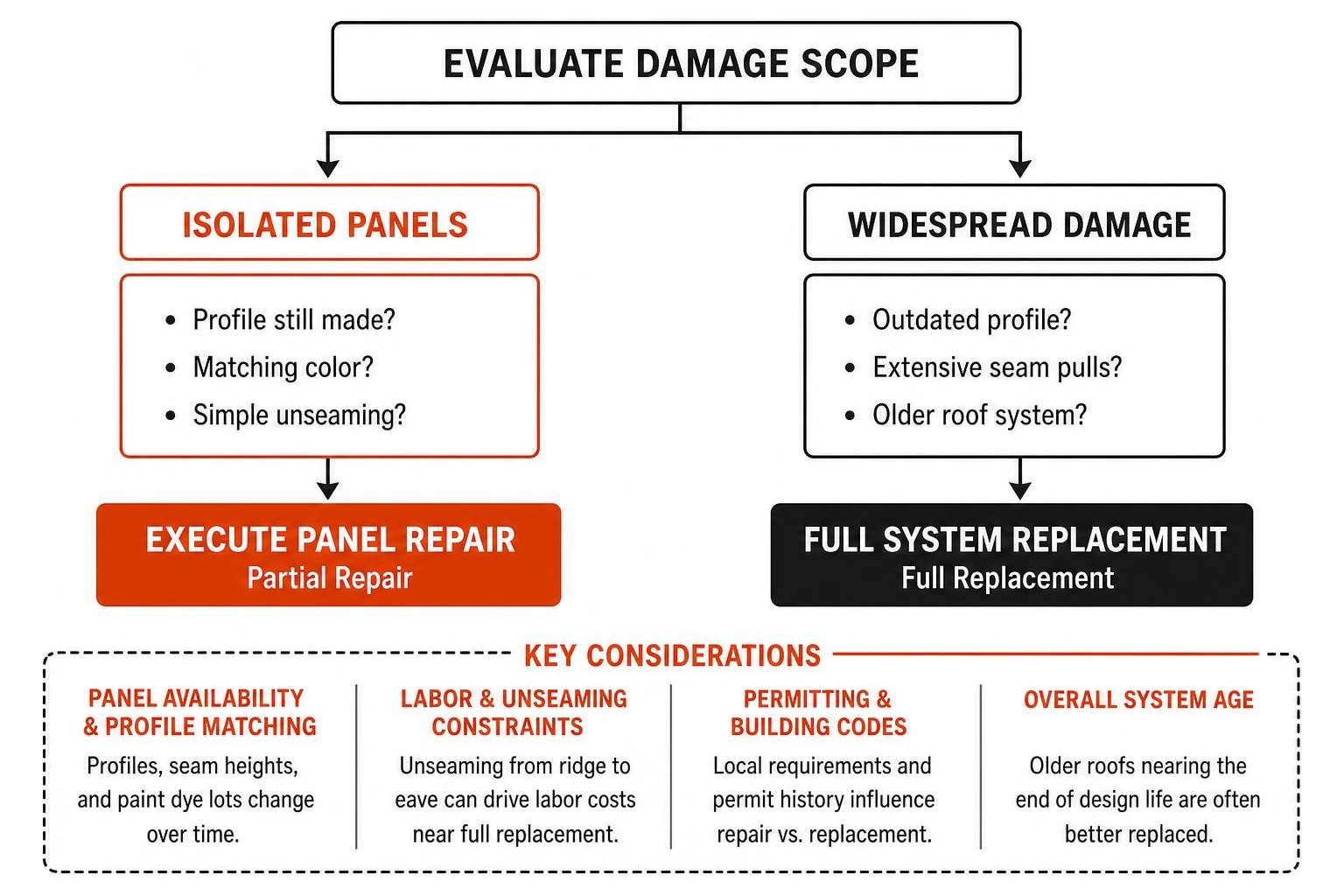
Deciding between replacing individual damaged panels and completing a full roof replacement involves several practical considerations:
- Panel Availability and Profile Matching: Metal panel profiles, seam heights, and paint dye lots change over time. If the original profile is obsolete, partial repairs may not seat correctly into existing seams.
- Labor and Unseaming Constraints: On mechanically seamed standing seam roofs, replacing a panel in the middle of a roof plane often requires unseaming every panel from the ridge cap down to the eave, which can drive labor costs near the threshold of a full slope replacement.
- Permitting and Building Codes: In jurisdictions across Brevard County, including Titusville and West Melbourne, repair scope, local building department requirements, and permit history influence whether a partial repair is approved or a complete reroof is necessary.
- Overall System Age: If an exposed-fastener roof is nearing the end of its design life, investing in extensive panel repairs is generally less economical than evaluating overall metal roofing costs in Florida for a modern, impact-rated replacement.
Frequently Asked Questions About Hail-Dented Metal Roofs
Can hail dents cause a metal roof to leak years later?
Shallow cosmetic dents do not turn into leaks over time. However, if a severe strike causes undetected micro-fissures in the paint or loosens a concealed mounting clip, decades of thermal expansion and contraction can gradually work that seam loose. In coastal Florida climates, trapped salt moisture along fractured seams can slowly degrade fasteners and underlayment, eventually allowing water penetration.
What hail size is required to dent 24-gauge or 26-gauge steel?
Visible denting generally begins with hailstones measuring 1.25 to 1.5 inches in diameter striking flat surfaces at high velocity. Thicker 24-gauge steel offers superior resistance compared to lighter 26-gauge or 29-gauge metals. Hail smaller than 1 inch rarely leaves permanent marks on quality steel panels unless driven by extreme, tornadic winds striking at a direct 90-degree angle.
Does homeowners insurance cover metal roof dent repairs?
Coverage depends entirely on your specific policy language. If your policy includes a cosmetic damage exclusion endorsement, claims for visible dents that do not cause active leaks or structural failure will likely be denied. If the storm caused functional damage—such as punctured panels, torn seams, or lifted flashings—the repair or replacement is typically covered under standard property damage provisions, subject to your policy deductible.
Preserving Your Metal Roof System
Hail events across the Space Coast can leave property owners uncertain about the condition of their roof. While most small indentations represent harmless cosmetic dimples that do not affect water-shedding performance, hidden seam distortions, loosened fasteners, or fractured coatings require timely professional attention to protect your home and maintain manufacturer warranty standing.
If a recent storm dropped hail over your home in Melbourne, Palm Bay, Rockledge, Viera, or Merritt Island, contact MLG Roofing for a detailed inspection. Our team provides unbiased assessments, clear documentation for your insurance provider, and expert professional roof repair services tailored to Florida’s coastal climate.